
Kuwaiti security forces repelled an armed infiltration attempt by six members of Iran’s Islamic Revolutionary Guard Corps on Bubiyan Island in the early hours of May 1.
The group approached aboard a rented fishing boat and exchanged fire with Kuwaiti troops after landing was challenged, leaving one soldier wounded.
Four suspects were detained while two others escaped back to sea.
Kuwait’s Ministry of Interior announced the arrests on May 12 and summoned Iran’s ambassador to deliver a formal protest note over the violation of sovereignty.
The four men in custody have been identified as two IRGC naval captains, one naval lieutenant and one army lieutenant.
Bubiyan Island covers 863 square kilometres and lies in Kuwait’s northwest waters near the Iraqi border and the Shatt al-Arab waterway. Its northern position gives control over key maritime approaches in the northern Gulf.
The island hosts the Mubarak Al-Kabeer Port, a multi-billion-dollar project financed largely by Chinese investment under the Belt and Road Initiative. Once complete the facility is expected to handle several million containers annually and reposition Kuwait as a regional logistics hub.
Construction has proceeded in phases since 2019 with Chinese contractors and local partners continuing work despite the security incident.
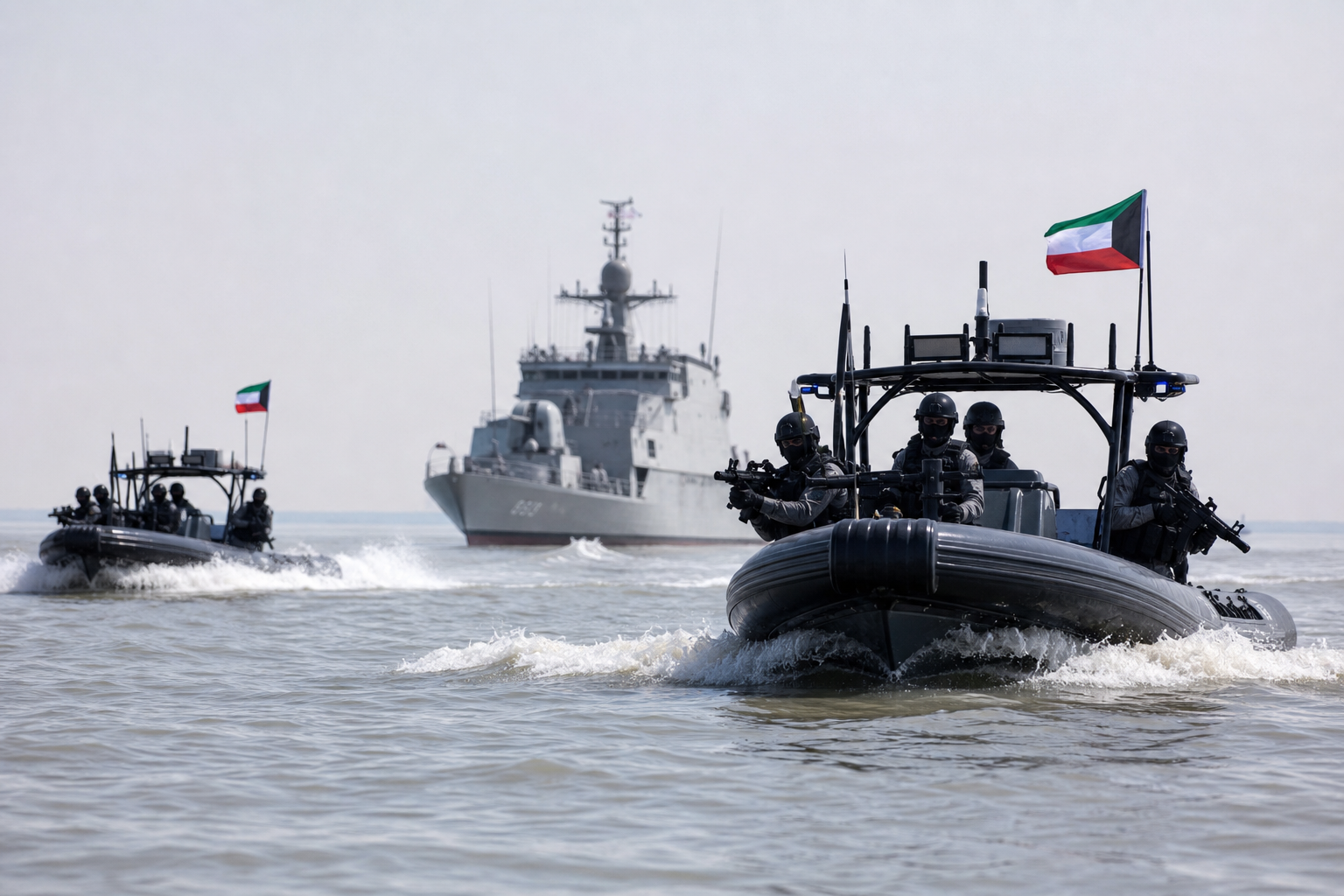
The attempted landing fits a pattern of IRGC naval operations that rely on small fast boats for covert insertion. Kuwaiti forces responded with standard coastal defence protocols and secured the area within minutes.
Investigators are examining the rented vessel, weapons recovered and communications equipment carried by the suspects to determine the full scope of the operation.
Qatar’s Ministry of Foreign Affairs described the action as “a blatant violation of Kuwait’s sovereignty and a dangerous escalation threatening the security and stability of the region.”
Al Jazeera reported that Kuwait arrested four men it accuses of being members of Iran’s Islamic Revolutionary Guard Corps after they allegedly tried to infiltrate Bubiyan Island by sea and injured a Kuwaiti soldier.
Reuters confirmed the timeline of the May 1 approach and the subsequent diplomatic summons.
The National noted that the target island hosts the China-backed port, raising questions about possible motives to disrupt economic infrastructure.
Kuwait has long maintained correct but cautious relations with Iran since the 1979 revolution. Tensions have periodically flared over maritime boundaries and alleged proxy activity.
The IRGC, established in 1979, maintains separate naval units trained for asymmetric operations in the Gulf and Strait of Hormuz. Kuwaiti officials view any IRGC presence near its territory as an immediate security threat.
Following the announcement, Kuwaiti authorities increased patrols around Bubiyan and neighbouring islands. Additional surveillance assets have been deployed to monitor fishing traffic and small craft movements.
The two fugitives remain at large. Kuwaiti coast guard vessels continue search operations in adjacent waters.
China’s embassy in Kuwait has not publicly commented, yet project managers report no interruption to port construction schedules. Work on berths and container terminals continues as planned.
Western diplomats based in the Gulf have privately expressed support for Kuwait’s right to defend its territory. The United States maintains a security partnership with Kuwait that includes joint exercises and intelligence sharing.
Regional observers note that any confirmed IRGC operation against a Gulf Cooperation Council state could prompt coordinated diplomatic responses from other GCC capitals.
Kuwait’s measured public statements have avoided inflammatory rhetoric while clearly assigning responsibility. The government has requested a full explanation from Tehran through official channels.
The suspects will face charges under Kuwaiti law including illegal entry, weapons possession and assault on security personnel. Trials are expected to proceed in closed sessions given the sensitive nature of the case.
Security analysts highlight Bubiyan’s dual military and economic value. The island’s geography allows observation of shipping lanes while the new port promises to generate significant non-oil revenue for Kuwait’s economy.
Iran has not yet issued an official response to the protest note. Past incidents involving alleged IRGC maritime activity have typically been met with denials from Tehran.
The episode occurs against a backdrop of wider Gulf friction including tanker seizures and drone incidents reported over the past two years. Each event incrementally raises the risk of miscalculation.
Kuwaiti citizens interviewed in the capital expressed concern over border security yet voiced confidence in the armed forces’ ability to respond. Public statements from the Interior Ministry have emphasised that the territory remains fully under government control.
Enhanced radar coverage and drone patrols are among the immediate measures under consideration for the northern islands. Funding for these upgrades may draw on existing defence allocations.
International shipping insurers are monitoring developments, though no immediate change to premium rates has been announced. The port project’s timeline remains on track for phased openings through 2028.
The four arrested men are being held in a secure facility while interrogation continues. Kuwaiti authorities have not released names or photographs pending further investigation.
Diplomatic sources expect the incident to feature in upcoming GCC foreign ministers’ meetings. Coordinated messaging on maritime security could follow.
China’s continued investment in Kuwaiti infrastructure demonstrates Beijing’s long-term interest in Gulf stability independent of regional rivalries. Both Kuwait and China have signalled commitment to completing the port regardless of security challenges.
The May 1 confrontation lasted only minutes yet has already produced measurable diplomatic fallout. Kuwait’s swift arrest and public disclosure have set the tone for how similar threats will be handled in the future.