
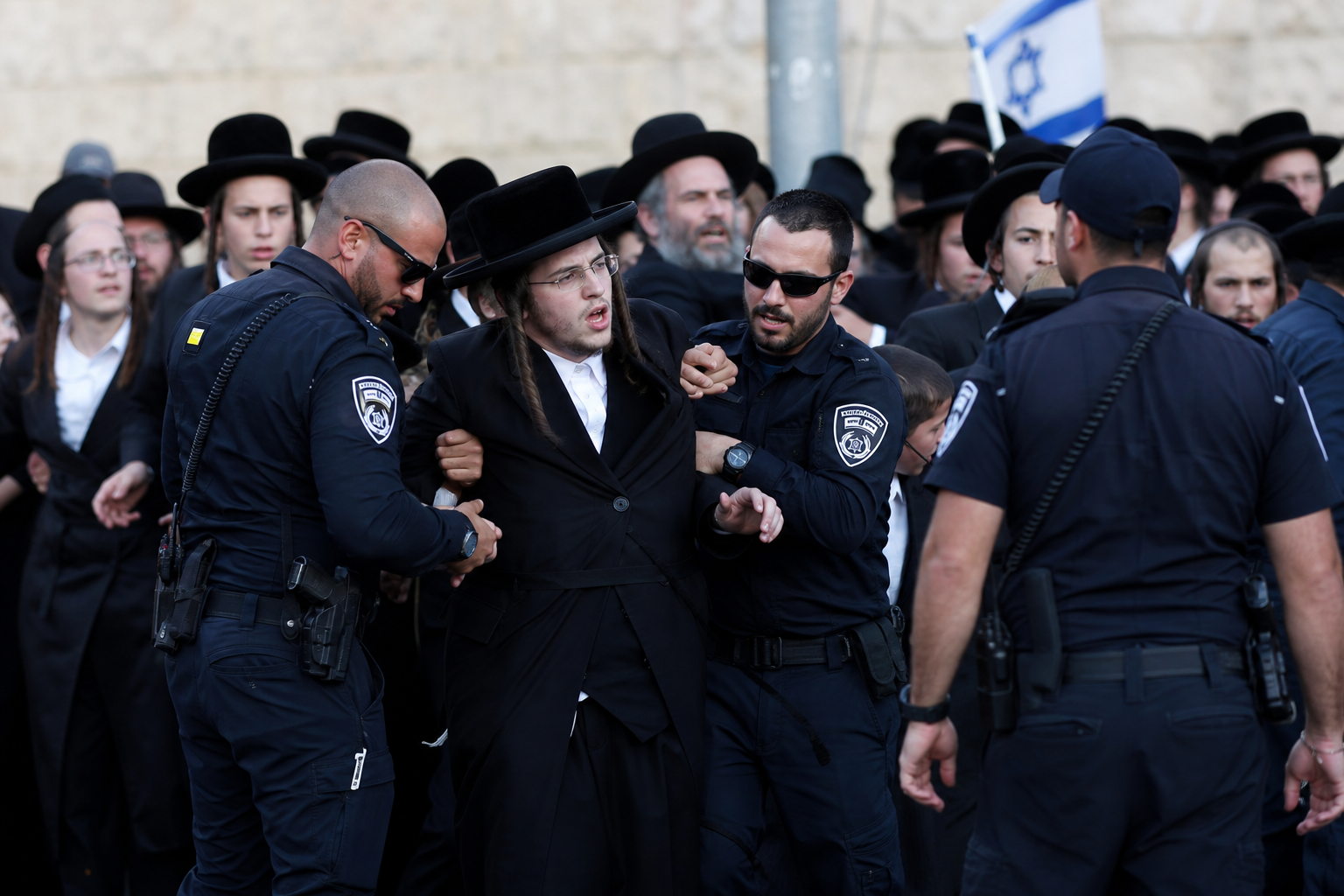
Two ultra-Orthodox Jewish men were detained after they ripped down Israeli flags from street poles in Beit Shemesh on the eve of Memorial Day.
The arrests occurred on April 20, 2026, when police responded to reports of the men using long poles to pull down both Israeli national flags and municipal flags from lampposts. Video footage captured by witnesses and later broadcast by outlets including Al Jazeera and CNN showed the pair methodically targeting the symbols in a residential area of the city known for its large ultra-Orthodox population.
Passersby confronted the men as they worked, leading to heated exchanges on the street. One witness later described seeing the flags being yanked down and discarded. The confrontation drew a quick response from local police units, who took both individuals into custody for questioning.
Israel Police issued a statement calling the act ugly and despicable. A spokesperson said police had arrested two ultra-Orthodox extremists allegedly seen tearing down Israeli flags in Beit Shemesh on the eve of Memorial Day. The force emphasized that such actions would not be tolerated, especially during a period when the country prepares to honor fallen soldiers and victims of terrorism.
The timing amplified public anger. Memorial Day, observed on April 21 in 2026, begins with a nationwide siren and flag displays at homes, public buildings, and street poles. Removing those flags hours before the siren sounded struck many residents as a deliberate provocation. Beit Shemesh police commander Inspector David Levy told reporters that officers arrived within minutes and secured the scene without further violence.
Local resident Miriam Goldstein, who lives near the street where the incident unfolded, said she heard shouting and stepped outside to see two men in traditional ultra-Orthodox attire reaching for the flags with extendable poles. Goldstein stated that several neighbors tried to stop them, but the men continued until police intervened. She added that the sight left her shaken because the flags represent both national identity and remembrance for families who lost relatives in wars and attacks.
Broader tensions between segments of the ultra-Orthodox community and the state surfaced once again through the episode. Certain Haredi groups maintain ideological opposition to Zionism and refuse to recognize the legitimacy of the Israeli state on religious grounds. While most ultra-Orthodox citizens serve in the military or participate in civic life, small factions continue to reject national symbols such as the flag and the national anthem. Police sources indicated the two arrested men appeared to belong to this anti-Zionist fringe.
TRT World reporter Aisha Rahman, who reviewed the circulated video, noted that the men focused exclusively on Israeli and city flags while ignoring other decorations. Rahman reported that officers described the act as a targeted ideological statement rather than random vandalism. The two suspects were transferred to a local station for further interrogation and possible charges of damaging public property and disturbing public order.
Political reactions followed swiftly. Members of the Knesset from across the spectrum condemned the flag removals. Opposition MK Yair Lapid posted that disrespecting the flag on Memorial Day eve crossed every line of decency. Coalition MKs echoed similar sentiments, calling for stricter enforcement against anti-state actions within insular communities.
Beit Shemesh Mayor Aliza Bloch issued a statement expressing outrage and pledging to increase patrols around public symbols during national memorial periods. Bloch, who has long navigated relations between the city’s secular, modern Orthodox, and ultra-Orthodox residents, said the incident did not represent the majority of the Haredi population, many of whom quietly raise flags at their own homes.
Community leaders within Beit Shemesh’s ultra-Orthodox neighborhoods offered mixed responses. Rabbi Shmuel Pappenheim, a local spokesman for several Hasidic courts, distanced mainstream groups from the two men. He told Israeli radio that most residents respect the law even when they hold differing theological views. Pappenheim added that isolated extremists should not be used to paint entire communities as hostile to the state.
Video evidence played a central role in the rapid arrests. Multiple angles filmed by residents and later aired by CNN showed the men methodically working their way down the block. One clip captured a passerby pleading with them to stop, while another showed the flags falling to the pavement. Police confirmed they used the footage to identify and locate the suspects within hours.
The incident fits into a pattern of occasional flag-related disputes in ultra-Orthodox areas during national holidays. Similar episodes have occurred in Jerusalem’s Mea Shearim neighborhood and parts of Bnei Brak, though arrests remain relatively rare. Authorities usually issue warnings first, but the deliberate timing on Memorial Day eve prompted a stronger response this time.
Public discourse online reflected deep divisions. Some users expressed fury at what they viewed as treasonous behavior, while others urged calm and called for dialogue rather than blanket condemnation of ultra-Orthodox citizens. Local Beit Shemesh Facebook groups filled with photos of the damaged flags and calls for residents to replace them before the siren sounded the next morning.
By the evening of April 20, replacement flags had already been hung on several poles. City workers assisted residents in restoring the displays, ensuring the streets would be properly adorned for the memorial siren at 8 p.m. the following day. Police maintained a visible presence in the neighborhood overnight to prevent further incidents.
Legal proceedings against the two men were expected to begin within days. Prosecutors indicated they would consider charges of vandalism and possibly incitement, depending on evidence gathered during interrogation. Both suspects remained in custody pending a court hearing scheduled for the week after Memorial Day.
The event underscored ongoing challenges in integrating anti-Zionist ideological pockets into a society that places heavy symbolic weight on national emblems during times of collective mourning. While the vast majority of Israel’s ultra-Orthodox population does not participate in such acts, isolated provocations continue to test communal relations in mixed cities like Beit Shemesh.
Authorities urged residents to report any further suspicious activity around public flags. Inspector Levy emphasized that protecting national symbols during sensitive periods remained a priority for law enforcement. The two arrests, he said, sent a clear message that such behavior would face immediate consequences.