
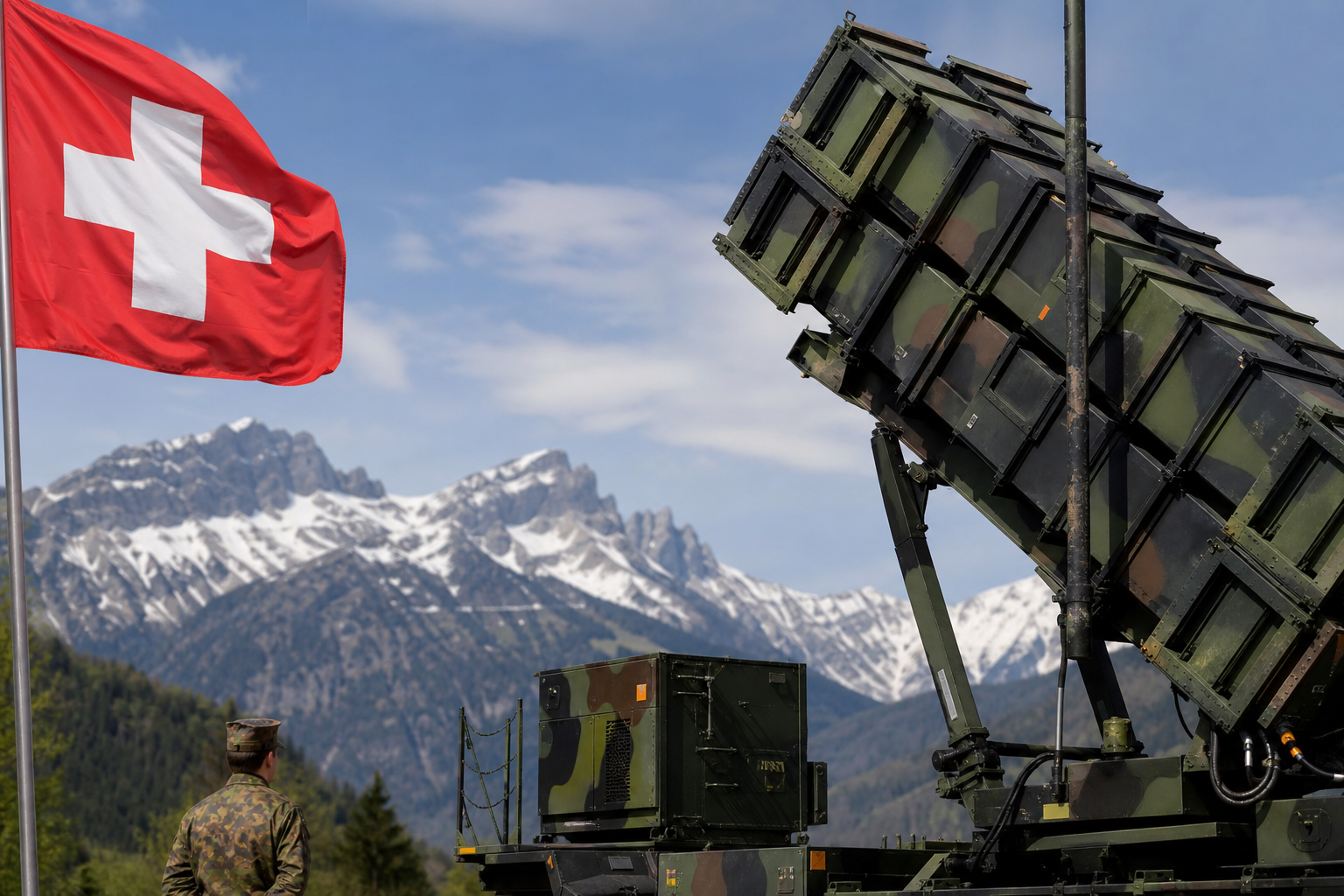
Switzerland has begun a rapid evaluation of rival long-range air-defense systems after the United States warned of additional multi-year delays and higher prices for Patriot batteries ordered four years ago.
The announcement came on May 13, 2026, when Swiss authorities confirmed they had contacted five manufacturers across four countries. Payments to the United States for the original order have been placed on hold while the new review proceeds.
Switzerland ordered five Patriot systems in 2022 with deliveries originally scheduled between 2026 and 2028. The timeline had already slipped by four to five years because of production pressures created by the war in Ukraine. Recent developments tied to the conflict involving Iran have now triggered further postponements of five to seven years and substantial price increases.
Officials expect written responses from the five suppliers by the end of May 2026. The contacted companies are based in Germany, France, Israel and South Korea. A government statement noted that every alternative path would produce its own delivery delays and extra costs.
Kaj-Gunnar Sievert, spokesperson for the Swiss defense procurement agency Armasuisse, confirmed the outreach. He stated that Switzerland has approached manufacturers from four countries to inquire about air defense systems it is considering procuring amid delays in the delivery of the Patriot system.
The decision reflects Switzerland’s long-standing policy of armed neutrality. The country maintains no standing alliances yet invests heavily in territorial defense. Airspace protection has become a higher priority since Russian forces invaded Ukraine in 2022 and subsequent regional tensions escalated. Swiss planners continue to monitor regional airspace activity closely to ensure adequate coverage for population centers and critical infrastructure sites across the alpine nation.
Under the original contract, the five Patriot units were intended to replace older systems and provide extended-range coverage over key population centers and military installations. Swiss planners had counted on initial operational capability by the late 2020s. Revised estimates now point to the mid-2030s at the earliest if the United States remains the supplier. Additional planning sessions have been scheduled to review integration requirements with existing radar networks.
The additional delays stem from sustained high demand for Patriot interceptors and launchers. Production lines in the United States are fully committed to existing contracts for Ukraine and other partners. The latest conflict involving Iran has further strained component availability and raised material costs. Supply chain experts within the Swiss procurement team are now modeling multiple scenarios to mitigate future shortages.
Switzerland’s Federal Council emphasized that no final choice has been made. The government will compare technical performance, delivery schedules, life-cycle costs and political export conditions before selecting a system or combination of systems. Detailed briefings for senior military leadership are already underway to align expectations with realistic timelines.
Potential German options include advanced ground-based systems developed by Diehl Defence and other European consortia. French proposals center on the SAMP/T platform produced by Eurosam. Israeli firms are expected to offer variants of the Arrow family or complementary long-range interceptors. South Korean manufacturers have been invited to present the Cheongung II system and related upgrades. Each proposal will undergo rigorous technical evaluation by specialized committees in the coming weeks.
Each candidate brings distinct advantages and constraints. European systems may benefit from shorter political approval timelines inside the European Union framework, though Switzerland is not an EU member. Israeli technology offers combat-proven performance but requires careful navigation of third-party export restrictions. South Korean equipment is viewed as cost-competitive with rapid production potential. Procurement teams are preparing comparative matrices to highlight performance differences under alpine terrain conditions.
Defense analysts note that any switch will require new training programs, infrastructure modifications and integration with Switzerland’s existing command-and-control network. These factors add months or years to whatever timeline is ultimately chosen. Simulation exercises are being planned to test compatibility with current Swiss communication protocols.
The Swiss government has not ruled out maintaining a reduced Patriot order if Washington can provide firm revised dates and acceptable pricing. Officials continue to receive updates from American counterparts while parallel talks with alternative suppliers advance. Regular coordination calls have been established to keep all parties informed of progress.
Parliamentary committees in Bern are scheduled to receive confidential briefings on the evaluation process before the summer recess. Public details remain limited to protect ongoing commercial negotiations. Lawmakers have requested additional data on long-term maintenance requirements for each candidate system.
Switzerland’s geographic position between major European powers makes credible air defense a core element of its security doctrine. Recent airspace violations reported by neighboring countries have reinforced the urgency expressed by military planners. Enhanced surveillance measures are being considered alongside the procurement review.
Industry sources indicate that initial cost estimates for non-American systems range from 15 to 30 percent above the original Patriot contract, depending on configuration and support packages. Delivery of the first operational batteries under any alternative could begin as early as 2031 if contracts are signed before the end of 2026. Budgetary adjustments will be presented to parliament as part of the autumn financial planning cycle.
The Federal Council statement concluded that all options would lead to delivery delays as well as substantial additional costs. This assessment will guide the final recommendation expected later this year. Comprehensive risk assessments are being compiled to support the decision-making process.
International partners are watching the Swiss process closely. A decision favoring a European system could strengthen continental defense supply chains. Selection of an Israeli or South Korean platform would highlight the global nature of current air-defense markets. Bilateral discussions with potential suppliers continue at a steady pace.
Swiss neutrality rules prohibit permanent foreign military bases, so whichever system is chosen will be operated exclusively by Swiss personnel. Training will occur either domestically or at approved foreign facilities under strict controls. Detailed training curricula are under development to ensure seamless transition for operators.
Procurement officials have already begun preliminary discussions with national infrastructure agencies to identify potential new launch sites and radar locations that could accommodate different system footprints. Environmental impact studies will accompany site selection to comply with national regulations.
The outcome will shape Swiss air defense for the next three decades. Lawmakers expect a comprehensive report by early autumn 2026 before any binding financial commitments are approved. Public consultations may follow the release of the final recommendation to gather broader input.