
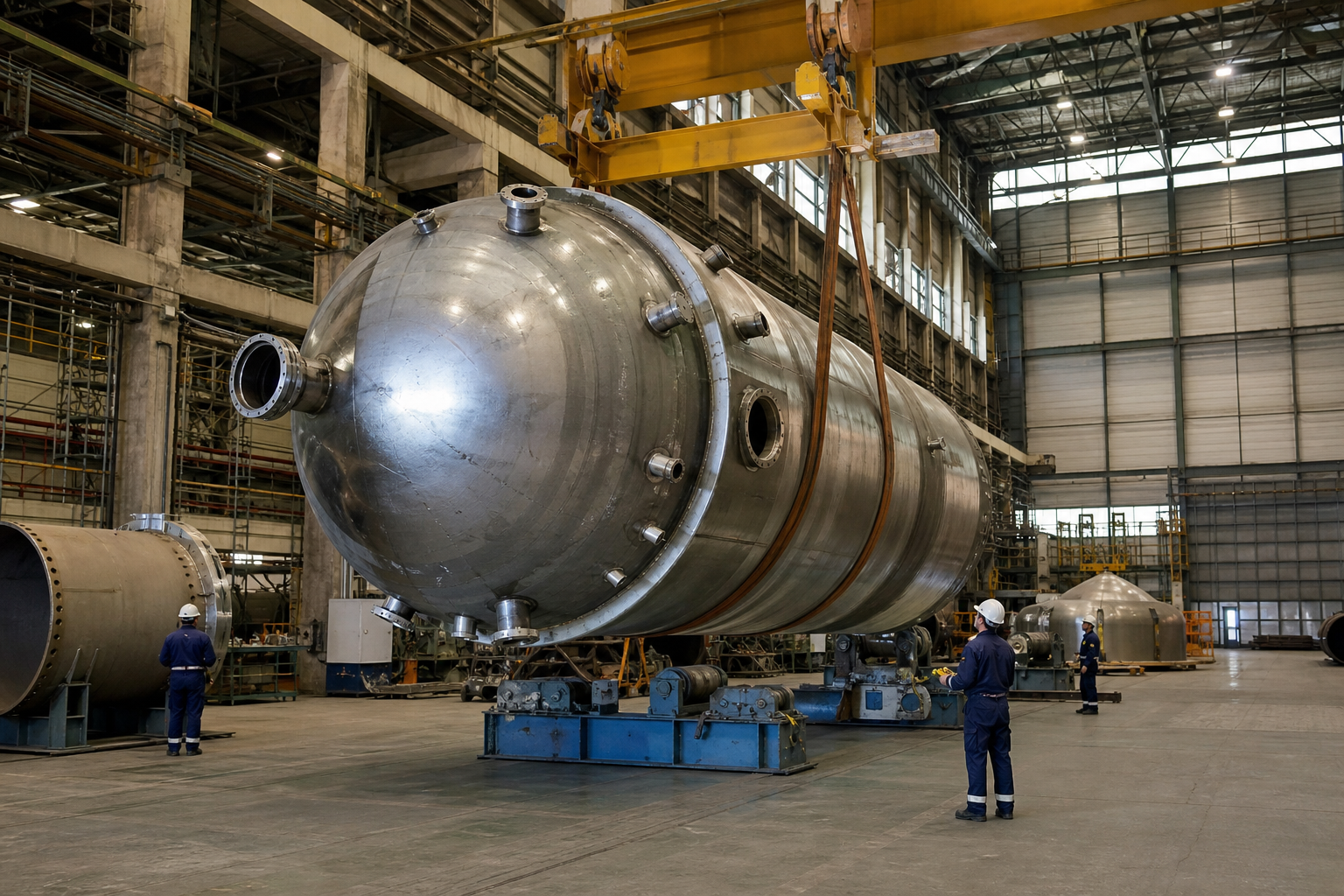
The U.S. Department of Energy is preparing to commit billions of dollars toward early purchases of critical components for new nuclear reactors.
This step targets long-lead-time items that take years to manufacture, allowing utilities to shorten overall construction schedules for AP1000 plants. Nuclear Energy Institute President and CEO Maria Korsnick confirmed the plans on May 12, 2026, noting the effort would support several U.S. utility companies interested in AP1000 deployment.
The financing would come from the DOE’s Office of Energy Dominance Financing, which holds hundreds of billions in loan authority. Officials are examining how to release funds specifically for reactor pressure vessels, steam generators, and other major parts that normally require three to five years of lead time before any concrete is poured at a site.
Five or six utilities have already reached very advanced stages in seeking these loan guarantees, according to Cameco President and COO Grant Isaac. Speaking on May 7, 2026, Isaac said the companies want to order long-lead items ahead of final project approvals to compress delivery schedules.
The targeted fleet could reach as many as 10 AP1000 reactors, with some internal estimates suggesting potential for up to 20 units if early orders prove successful. Each AP1000 is a Westinghouse-designed pressurized-water reactor rated at roughly 1,100 megawatts, capable of powering about one million homes while producing near-zero carbon emissions during operation.
Previous AP1000 projects at Vogtle in Georgia demonstrated both the technology’s promise and its challenges. The first two units took more than a decade to complete and cost far more than initial estimates, largely because supply-chain delays and regulatory reviews stretched timelines. Financing long-lead components earlier is intended to prevent similar bottlenecks on future builds.
Utilities exploring the new financing route are located across the Southeast, Midwest, and Mid-Atlantic regions. Exact names remain confidential while negotiations continue, but the group includes both regulated investor-owned companies and public power entities. Their interest reflects growing demand for reliable, always-available carbon-free electricity to support data centers, manufacturing resurgence, and state clean-energy mandates.
The Nuclear Energy Institute has argued that federal support for early procurement can reduce total project risk and attract private capital. Korsnick stated that the DOE move “is going to help several U.S. utility companies who are interested in AP1000 deployment.” She added that the timing aligns with utilities needing firm power sources that can operate around the clock regardless of weather conditions.
Industry analysts note that global competition for nuclear components is intensifying. South Korea, China, and Russia maintain active supply chains for large forgings and reactor internals. By locking in U.S. orders now, the DOE financing could help domestic and allied manufacturers expand capacity and reduce reliance on foreign vendors.
Loan guarantees would function similarly to those provided for the Vogtle expansion, covering a substantial portion of debt in case of cost overruns or delays. The Office of Energy Dominance Financing already possesses statutory authority under the Energy Policy Act of 2005 to back up to 80 percent of eligible project costs for innovative energy technologies, including advanced nuclear.
Grant Isaac emphasized that the utilities are focused on “advancing project delivery by considering things like ordering the long lead items ahead of time.” This approach mirrors strategies used successfully in China, where multiple AP1000 units were built on tighter schedules after initial units resolved supply-chain issues.
Environmental groups have offered mixed reactions. Supporters of nuclear power as a climate solution welcome the acceleration, while some critics question whether taxpayer-backed loans sufficiently address long-term waste storage and proliferation concerns. The DOE has not yet released detailed environmental reviews tied to the proposed financing.
Supply-chain experts say the first payments could flow within months if agreements are finalized. Major forgings for a single AP1000 require specialized mills in Japan, France, and the United States. Early funding would allow those mills to reserve production slots years in advance, avoiding the multi-year queues that have plagued past projects.
The potential scale of 10 to 20 reactors would represent the largest U.S. nuclear construction program since the 1970s. Combined output could exceed 20 gigawatts, enough to replace roughly 15 coal-fired plants and support growing electricity demand from electric-vehicle charging and industrial electrification.
Reuters first reported the DOE’s consideration of the financing package on May 12, 2026, citing statements from Korsnick. S&P Global Commodity Insights had earlier disclosed on May 7 that five or six utilities were in advanced talks, based on comments from Cameco executives. GuruFocus summarized the same developments the following day.
Implementation details remain under discussion inside the DOE. Staff must determine whether the financing will take the form of direct loans, loan guarantees, or a combination. Interest rates, repayment schedules, and required equity contributions from utilities are still being modeled.
Utility executives have privately told the Nuclear Energy Institute that securing long-lead financing is now the primary hurdle before they can issue full notices to proceed with engineering and site preparation. Without it, regulatory approval timelines risk pushing commercial operation dates into the mid-2030s.
The DOE’s willingness to act reflects broader bipartisan support for nuclear energy in Congress. Lawmakers from both parties have increased funding for nuclear research and demonstration projects in recent appropriations bills. The current financing proposal builds on that momentum without requiring new legislation.
Market observers expect additional utilities to join the queue once the first agreements become public. Several companies that previously retired coal plants are now evaluating nuclear repowering options at the same sites, citing existing transmission infrastructure and local workforces familiar with large industrial operations.
Manufacturing restarts would also benefit domestic steel and heavy-equipment sectors. Facilities in Pennsylvania, Ohio, and South Carolina that once supplied the nuclear industry are assessing whether to reopen production lines if firm orders materialize.
While the exact dollar figure for the DOE commitment has not been disclosed, industry sources familiar with the discussions describe it as “several billion dollars” spread across multiple projects. That amount would cover only the initial long-lead purchases, with full plant financing still requiring utility balance sheets and additional private debt.
The approach represents a pragmatic middle step between full government funding and pure private-sector risk. By targeting the longest-lead items, the DOE can accelerate schedules without assuming responsibility for entire power-plant construction.
Final decisions are expected before the end of 2026. If agreements are reached, the first reactor pressure vessels could be ordered as early as 2027, setting the stage for groundbreaking on new U.S. nuclear units before the decade closes.