

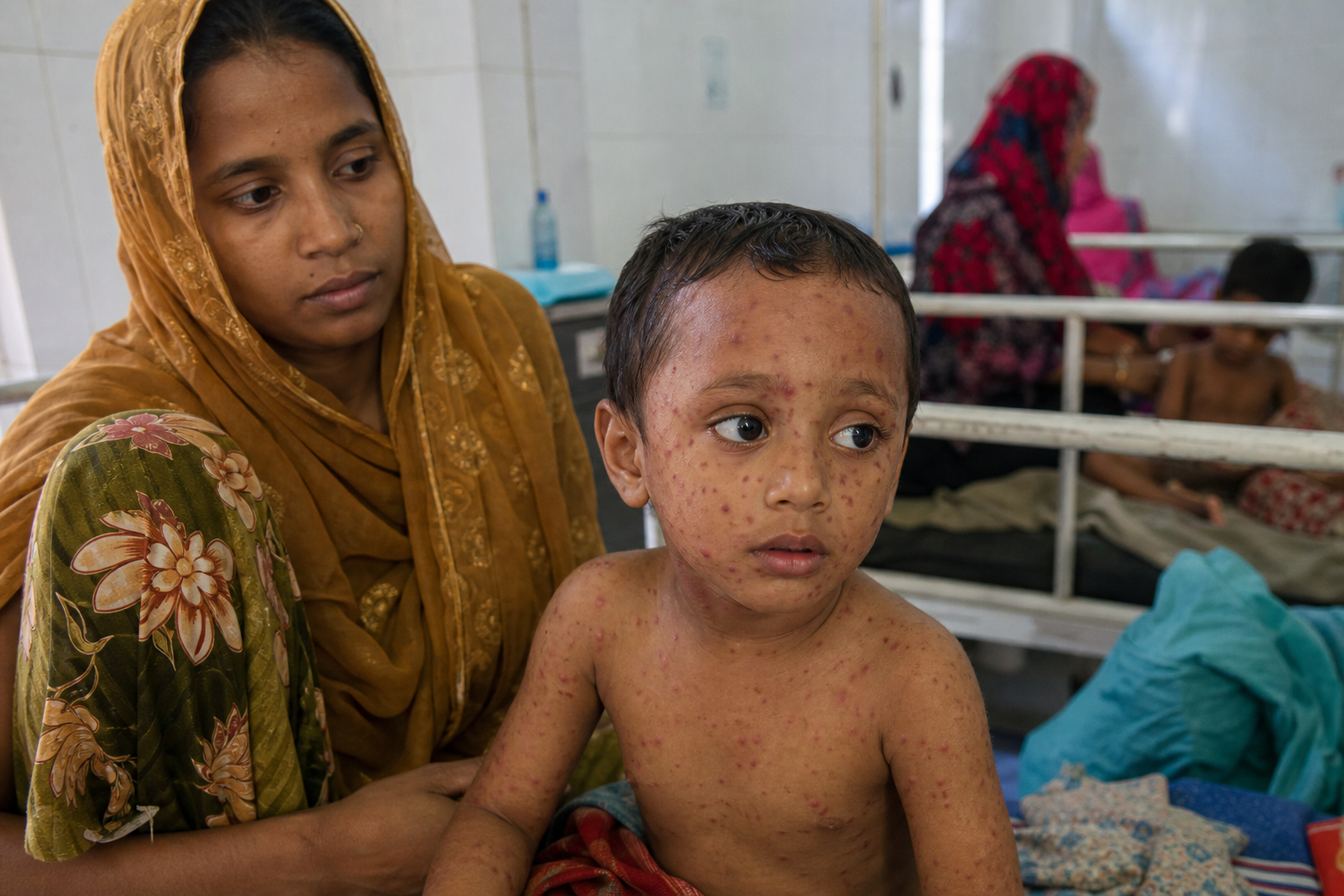
Bangladesh recorded an alarming 1,115 new suspected measles cases in just one day as the outbreak continues to ravage the country.
Health authorities confirmed the spike on May 13, 2026, with 127 of those cases verified through laboratory testing. The single-day total marks one of the sharpest increases since the outbreak began on March 15, 2026. Nationwide suspected cases have now crossed 51,000, while laboratory-confirmed infections stand above 6,900. At least 336 children have died.
The surge spans all 64 districts, leaving no region untouched. Hospitals in major cities report wards filled with children suffering high fevers, rashes, and respiratory complications. Rural clinics struggle with limited supplies of vitamin A and basic antibiotics needed to manage secondary infections.
Health experts trace the rapid spread directly to falling vaccination rates. Coverage dropped to 59 percent in 2025 after the interim government took power following the 2024 uprising. Routine immunization campaigns lost momentum as resources shifted and public trust eroded in several areas.
Prof Be-Nazir Ahmed emphasized that the immunity gap allowed the virus to circulate freely even among partially vaccinated communities. He noted that measles remains one of the most contagious diseases known, capable of infecting up to 90 percent of susceptible people in close contact.
Abu Hussain Md Moinul Ahsan, a senior Health Ministry official, added context on the limits of partial protection. Without herd immunity, outbreaks can still occur even among vaccinated populations. He stressed that the current coverage level leaves millions of children vulnerable across every district.
The Daily Star reported on May 10 that officials had already documented more than 45,000 cases and 294 deaths by early May. Daily Sabah followed on May 8 with figures showing the toll had climbed past 50,000 suspected cases and 336 deaths, linking the acceleration to disruptions that began after the 2024 political changes.
Parents in affected districts describe sudden onset of symptoms in children who had missed routine shots. In one Dhaka neighborhood, families waited hours outside overburdened clinics only to learn that measles vaccine stocks had run low. Similar scenes unfolded in Chattogram, Sylhet, and Rajshahi divisions.
Public health workers say the drop in routine immunization began gradually in late 2024 and accelerated through 2025. Mobile vaccination teams faced fuel shortages and security concerns in some zones, while school-based campaigns lost coordination when many institutions closed during unrest.
Measles complications such as pneumonia and encephalitis have driven most fatalities among children under five. Malnutrition, already prevalent in parts of the country, worsens outcomes. Survivors sometimes face lifelong hearing loss or vision impairment.
International health agencies have offered technical support, yet distribution of additional vaccines requires stable cold-chain logistics that remain strained in remote upazilas. The government has launched emergency mop-up campaigns in the hardest-hit districts, but uptake remains uneven.
Daily WION coverage on May 8 highlighted the 1,115-case spike and noted that confirmed infections continue rising despite these efforts. Officials acknowledge that contact tracing has become nearly impossible given the volume of new patients arriving daily.
Community leaders in rural areas report that misinformation about vaccine safety spread rapidly after the political transition. Some families now hesitate to bring children forward even when doses are available. Health educators have intensified door-to-door visits to counter these fears with simple explanations of measles risks.
Economic pressures compound the crisis. Families lose income when parents must stay home to care for sick children. Schools that reopened after the 2024 events now face fresh closures in villages reporting clusters, disrupting education for thousands of students.
Historical data show Bangladesh had achieved higher measles coverage before 2024, keeping annual cases below 1,000 in most years. The current trajectory reverses years of progress and threatens neighboring countries with cross-border transmission if containment fails.
Health ministry teams continue daily tallies from every district health office. On May 13 alone the 1,115 new suspected cases represented a 40 percent jump over the previous day average. Laboratory capacity has been expanded to process more samples, yet confirmation still lags behind clinical reports.
Prof Be-Nazir Ahmed warned that without rapid restoration of coverage above 95 percent in every upazila, further waves remain likely. He called for an immediate national campaign combining fixed posts and outreach teams to reach children missed during the past two years.
Abu Hussain Md Moinul Ahsan echoed the urgency, noting that every week of delay adds hundreds more preventable infections. He said the ministry is requesting additional funding for vaccine procurement and cold-chain equipment to sustain the response through the monsoon season when respiratory illnesses typically rise.
Local non-governmental organizations have mobilized volunteers to support surveillance and referral of severe cases. These groups report that many parents only seek care after complications appear, underscoring the need for earlier detection at the community level.
The outbreak has drawn attention to broader weaknesses in primary healthcare delivery exposed since 2024. Routine services such as growth monitoring and nutrition counseling were deprioritized during the transition, leaving children more susceptible to severe measles outcomes.
Despite the grim numbers, some districts have begun to stabilize after intensive vaccination drives. Officials point to localized successes where coverage was restored above 80 percent within weeks, showing that rapid action can still bend the epidemic curve.
Parents who lost children to measles describe profound grief compounded by the knowledge that the disease is preventable. Their accounts underscore the human cost behind each daily statistic reported from district hospitals.
Health authorities continue to urge families to complete the two-dose measles vaccine schedule even if children received one dose previously. Catch-up immunization remains the only proven way to close the immunity gaps fueling the current surge.
As May progresses, the focus remains on scaling up both vaccination and supportive care. The 1,115 cases recorded on May 13 serve as a stark reminder that the window for decisive intervention is narrowing with each passing day.