
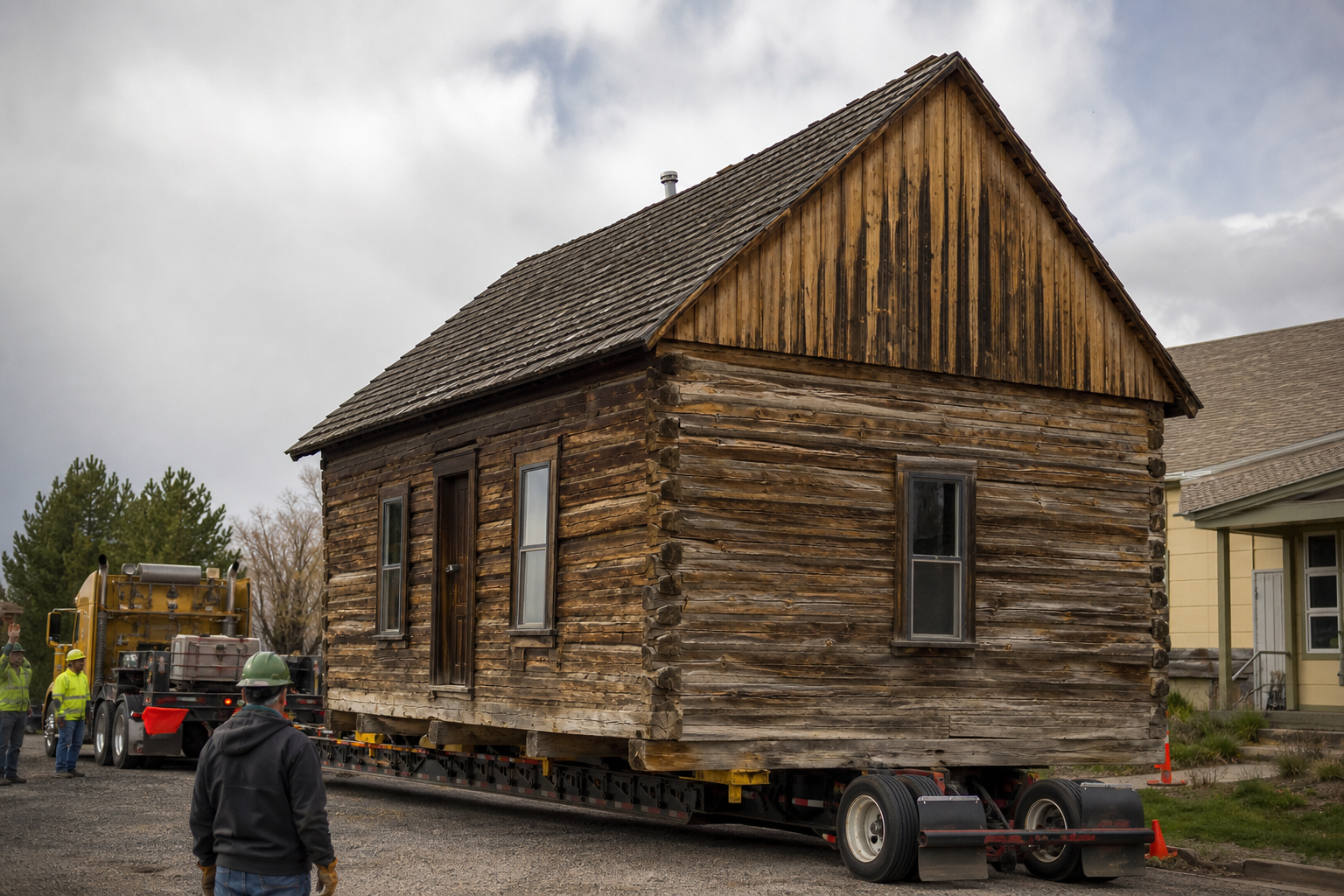
The massive Fossil Cabin began its final journey across the Wyoming plains on May 13, 2026.
The 52-ton structure made from more than 6,000 dinosaur bones traveled seven miles from Como Bluffs to the Medicine Bow Museum in 44 minutes under the direction of O’Neil House Moving crews.
Workers secured the fragile building onto specialized transport equipment early that morning before easing it onto the highway for the short but delicate trip.
Built in 1932 by Thomas Boylan, the cabin originally served as a roadside attraction along the old Lincoln Highway where travelers stopped to marvel at its unusual construction.
Boylan gathered the bones from the rich fossil beds at nearby Como Bluff, a site long known for yielding important dinosaur remains, and stacked them with mortar to form the walls of the one-story structure.
The result stood for more than nine decades as one of the most unusual buildings in the American West, drawing generations of visitors interested in paleontology and roadside Americana.
By the early 2000s the cabin had begun to deteriorate under Wyoming’s harsh weather, prompting its owners to seek a permanent solution for its care.
In 2018 the Nash family donated the building to the Medicine Bow Museum after extended negotiations and community fundraising efforts that addressed both the high cost and technical difficulties of any move.
Former museum director Sharon Biamon recalled the central obstacle during those years. “It was just too heavy,” she said, noting that repeated attempts to secure funding and engineering plans had stalled progress for nearly a decade.
Once funding was secured, planners poured a reinforced concrete pad beside the existing Owen Wister cabin at the museum grounds to receive the structure.
On moving day the O’Neil team lifted the entire cabin in one piece, a process that required constant monitoring to prevent any shifting that could crack the brittle fossil material.
Megan Stanfill of the Alliance for Historic Wyoming explained the unique preservation challenge. “One of the biggest challenges is dealing with the type of materials being used in the construction. Fossils are brittle. They’re very easily crumbled.”
Crews maintained a slow, steady pace throughout the 44-minute transport, stopping periodically to check tie-downs and the condition of the bone walls.
Local residents and museum supporters gathered along the route to watch the unusual procession as the cabin passed through the small community of Medicine Bow.
Reporters from Cowboy State Daily, Bigfoot99 and K2 Radio documented the arrival, showing the building being lowered gently onto its new foundation just after midday.
The cabin now sits adjacent to the Owen Wister cabin, creating a compact historic district at the museum that pairs the dinosaur-bone structure with the building associated with the author of the classic Western novel The Virginian.
Museum staff will spend the coming months completing interior stabilization work to protect the fossil walls from further weathering and to prepare safe public access.
Officials expect the renovated Fossil Cabin to open to visitors in 2027, allowing guests to step inside and examine the thousands of bones up close while learning about the 1930s era of dinosaur tourism in Wyoming.
The relocation marks the end of a long chapter for the cabin, which once stood isolated on the prairie and now joins a growing collection of preserved historic buildings at the Medicine Bow Museum.
Preservationists view the project as an example of how small communities can protect unusual landmarks that tell distinctive local stories even when the structures present extraordinary logistical hurdles.
With the move complete, attention turns to interpretive planning that will explain the cabin’s construction, its connection to Como Bluff’s paleontological legacy, and the decades-long effort that brought it to its current location.
The 52-ton building, once a solitary curiosity on the high plains, now occupies a protected spot where future generations can study both the ancient bones and the 20th-century ingenuity that assembled them into a home.