
A Roman doctor carrying his surgical instruments died in the final moments of Pompeii's destruction as pyroclastic flows swept through the city gates.
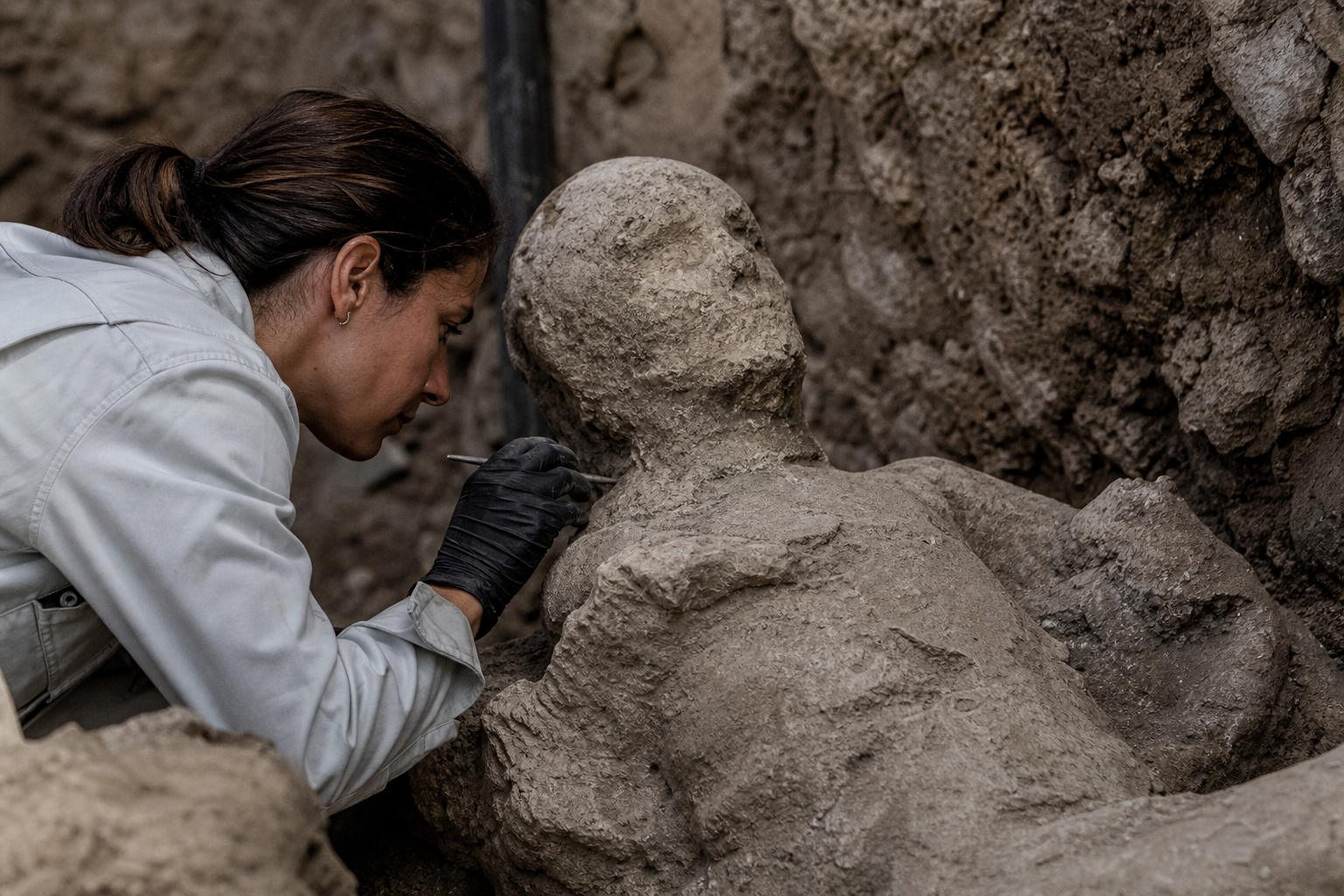
Archaeologists at the Archaeological Park of Pompeii have confirmed the identity of the victim through a medical kit preserved inside a plaster cast originally made during the 1961 excavation of the Orto dei Fuggiaschi area. The man was part of a group attempting to escape via Porta Nocera when Mount Vesuvius erupted in 79 AD.
Researchers applied X-rays, tomography and CT scans at the Maria Rosaria Nursing Home to examine the interior of the cast without causing damage. The images clearly showed a slate plate and several bronze surgical instruments positioned near the body, confirming the victim's profession as a practicing physician.
The discovery adds to the detailed picture of daily life in Pompeii before the disaster. Residents carried essential items as they fled, and this doctor chose to bring the tools of his trade rather than leave them behind.
Gabriel Zuchtriegel, director of the Archaeological Park of Pompeii, described the find in direct terms. "Already two thousand years ago, there were those who were not just doctors during set hours, but doctors at all times—even in the moment of their escape from the eruption, cut short by the pyroclastic cloud that engulfed a group of fugitives attempting to leave the city through Porta Nocera," he said.
Zuchtriegel further noted the practical purpose behind the man's decision. "This man brought his tools with him to be ready to rebuild his life elsewhere, thanks to his profession, but perhaps also to help others."
The Orto dei Fuggiaschi, or Garden of the Fugitives, lies near the southeastern edge of the ancient city. Excavators in 1961 uncovered multiple casts of people who had sought shelter or passage in that sector during the final hours of the eruption. The doctor's cast remained in storage and study for decades until modern imaging technology allowed closer inspection.
Plaster casting, pioneered at Pompeii by Giuseppe Fiorelli in the 1860s, involves pouring liquid plaster into the voids left by decomposed bodies inside hardened ash layers. The resulting casts preserve the exact position and sometimes the objects carried at the moment of death.
The medical kit identified inside the cast includes instruments typical of Roman surgical practice. Ancient physicians used bronze scalpels, forceps, probes and retractors for procedures ranging from wound treatment to minor operations. The presence of a flat slate plate suggests the doctor may have used it as a mixing surface for medicines or as a portable examination tray.
Roman medicine combined practical surgery with herbal remedies. Doctors traveled with compact kits that allowed them to treat patients on site. The Pompeii physician's decision to carry these items during flight indicates he viewed his skills as central to his identity and future prospects.
The eruption sequence began with earthquakes and a massive ash column that darkened the sky. By the time the lethal pyroclastic surges arrived, many residents had already attempted to leave through the city gates. The group near Porta Nocera included men, women and children whose casts were also recovered in the same area.
Analysis of the doctor's remains shows he was an adult male of average height for the period. No signs of prior injury appear on the visible bones, consistent with a healthy professional who maintained an active practice until the final day.
Park officials emphasize that the find does not represent an isolated case. Other casts from Pompeii have revealed soldiers carrying weapons, merchants with coins and keys, and families clutching household valuables. The doctor's kit stands out because it directly ties the victim to a specific occupation still recognizable today.
Interdisciplinary teams at the park continue to re-examine older excavations with non-invasive techniques. The same scanning methods applied to the doctor's cast have been used on frescoes, pottery and other organic remains to extract new information without physical disturbance.
Zuchtriegel highlighted the human element preserved in the cast. The doctor did not abandon his professional responsibilities even when survival became the immediate priority. His tools traveled with him as both livelihood and potential means of assistance to fellow fugitives.
Historical records indicate that physicians in the Roman world often operated independently or within small practices rather than large institutions. A portable kit allowed mobility across cities and provinces. The Pompeii example demonstrates how such professionals integrated into urban communities and maintained their equipment through crises.
The identification process required coordination between archaeologists, radiologists and conservators. Staff at the Maria Rosaria Nursing Home provided access to high-resolution imaging equipment normally used for living patients. The resulting data set allowed precise mapping of every object inside the cast.
Future plans at the Archaeological Park include public display of the cast alongside enlarged images of the medical instruments. Visitors will see the physical evidence that established the victim's identity more than 1,900 years after his death.
Comparable finds elsewhere in the Vesuvian region have included medical tools from Herculaneum and other settlements destroyed in the same eruption. The Pompeii doctor now joins this small but growing group of identified professionals whose final moments reveal the breadth of Roman society.
Excavation and conservation work at Pompeii remains ongoing. Teams focus on stabilizing structures, documenting frescoes and applying new technologies to previously studied areas. Each re-examination of stored materials, such as the doctor's cast, can yield fresh insights into the people who lived there.
The 79 AD event stands as one of the best-documented ancient disasters due to the preservation of entire city blocks and their inhabitants. The doctor's story adds a personal dimension to the statistics of loss. His tools, visible only through modern scans, speak to preparation, skill and the instinct to carry one's expertise into an uncertain future.
Park researchers continue to catalog the instruments in greater detail. Metallurgical studies may determine the exact composition of the bronze tools and any repairs made during the doctor's career. Such analysis could reveal patterns of use and maintenance common among Roman medical practitioners.
The cast itself will undergo further conservation to ensure long-term stability. Protective measures already in place at the park prevent environmental damage to the fragile plaster surface that has preserved the victim's final posture for nearly two millennia.
Public interest in Pompeii remains high, with millions of visitors each year. Discoveries like the identified doctor provide concrete connections to individuals rather than abstract historical events. The medical kit offers tangible proof of specialized professions operating within the ancient city.
Zuchtriegel and his team plan additional publications on the find. Detailed reports will include the full scan data, measurements of the instruments and comparisons with other medical kits recovered from Roman sites across the Mediterranean.
The story of this single victim illustrates broader patterns of Roman life. Physicians moved through cities treating patients, carried portable equipment and maintained their practice even under extreme pressure. The eruption cut that practice short, yet the tools survived inside the ash to tell the tale.