
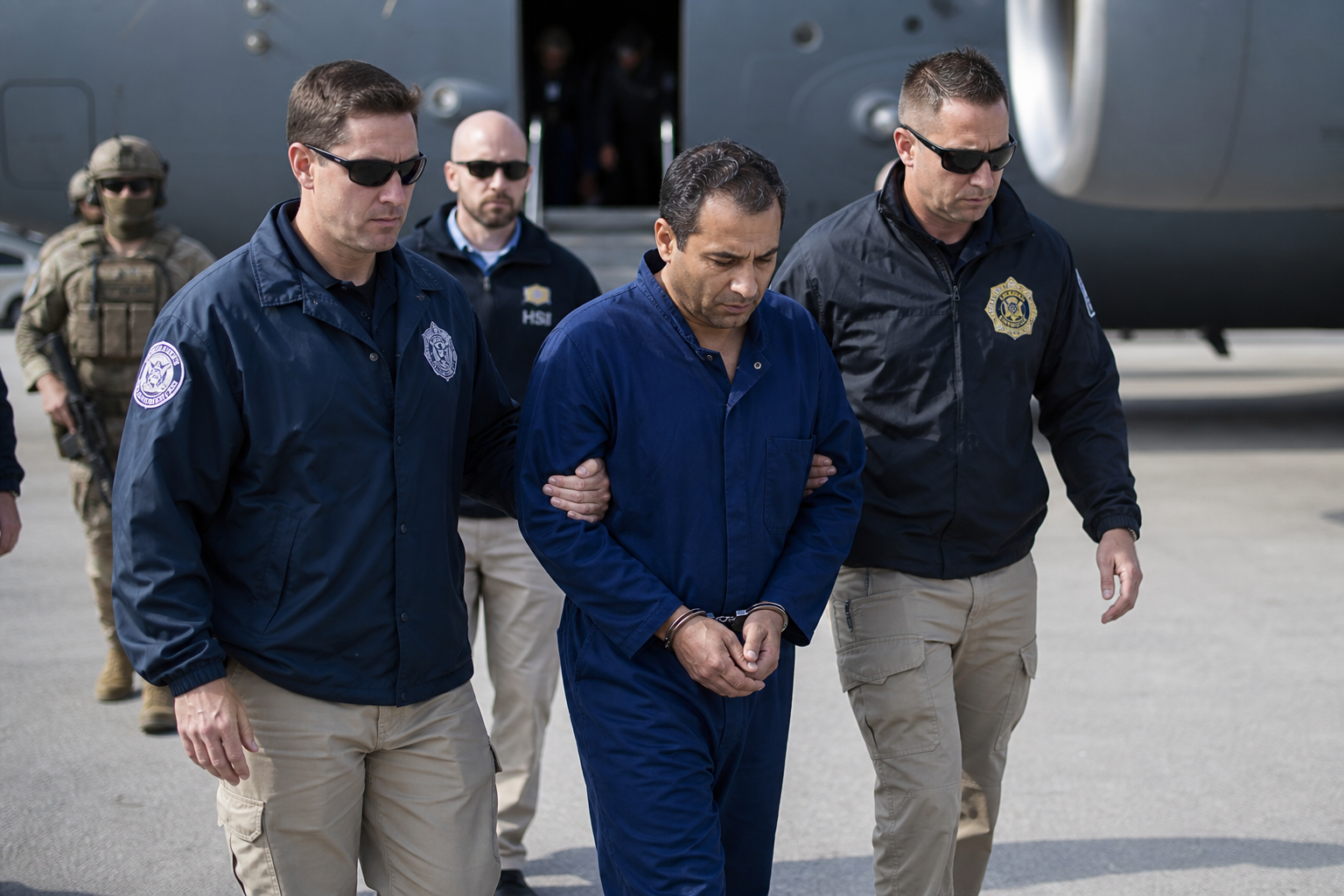
FBI agents escorted Mohammad Baqer Saad Dawood Al-Saadi into a federal courtroom in Manhattan in handcuffs after flying the 32-year-old Iraqi national from overseas custody. The commander in the Iran-backed group Kata’ib Hizballah faced six terrorism counts for directing nearly 20 attacks across Europe and Canada along with plots inside the United States. His appearance before U.S. Magistrate Judge Sarah Netburn on May 15, 2026, followed an arrest in Turkey and a direct transfer into American hands.
Prosecutors detailed how Al-Saadi coordinated operations that included bombings of public places and attempts to strike American targets on U.S. soil. The charges carry potential sentences up to life imprisonment. Court records show the case stems from activities dating back to at least March 2026 when a series of attacks began in multiple European cities. Canadian authorities also reported thwarted plots linked to the same network.
Al-Saadi rose through the ranks of Kata’ib Hizballah, a Shia militia long supported by Iran’s Islamic Revolutionary Guard Corps. The group has conducted rocket and drone attacks against U.S. forces in Iraq for years and was designated a foreign terrorist organization by the State Department. As a field commander, Al-Saadi allegedly shifted focus to external operations in Europe and North America while maintaining ties to IRGC handlers who provided funding and training.
The six counts include conspiracy to provide material support to Kata’ib Hizballah, conspiracy to provide material support to the IRGC, conspiracy to bomb a place of public use, and attempted destruction of property used in interstate commerce. Each material-support conspiracy carries a maximum of 20 years. The bombing conspiracy count allows for a life sentence if convicted. Federal agents gathered evidence through surveillance, communications intercepts, and cooperation with European partners that traced orders directly to Al-Saadi.
FBI Director Kash Patel issued a statement highlighting the operation. “The FBI’s successful FTOC of Mohammad Al-Saadi, another high-value target responsible for mass global terrorism, is just the latest success in this administration’s historic work to bring terrorists to justice,” Patel said. Officials described the case as part of a broader campaign against Iran-backed networks that have expanded operations beyond the Middle East in recent years.
U.S. Attorney for the Southern District of New York Jay Clayton emphasized the personal role Al-Saadi played. “Mohammad Baqer Saad Dawood Al-Saadi, a commander for the terrorist organization, Kata’ib Hizballah, faces serious charges for his role in numerous attacks against U.S. interests across the globe, including his efforts to kill on U.S. soil,” Clayton told reporters outside the courthouse. He noted that the defendant was ordered detained pending trial and would remain in federal custody in New York.
Turkish authorities arrested Al-Saadi earlier in May after receiving intelligence from U.S. and European agencies. He was held briefly in Istanbul before being handed over to FBI personnel for transport. The extradition avoided lengthy diplomatic proceedings because Al-Saadi lacked Turkish citizenship and faced serious terrorism allegations recognized under international agreements. Once airborne, agents monitored him throughout the flight to ensure no escape attempts or communications with outside contacts.
European security services have tracked Kata’ib Hizballah cells operating in several countries since early 2026. Attacks attributed to the network include explosive devices placed near diplomatic facilities and public transportation hubs in major capitals. Canadian officials separately disrupted two plots in Toronto and Montreal that involved reconnaissance of potential targets. Investigators believe Al-Saadi approved target lists and allocated resources sent through layered financial channels originating in Iran.
The case underscores ongoing U.S. efforts to disrupt Iran’s proxy operations far from the region. Kata’ib Hizballah has historically focused on Iraq but expanded its reach under IRGC direction. Analysts note that such groups now blend local militias with global cells capable of striking soft targets in Western countries. The extradition demonstrates how law-enforcement tools can reach commanders who previously operated with relative impunity outside conflict zones.
Israeli officials monitoring the proceedings welcomed the development as another blow to Iran’s network of proxies. Similar Shia militias have threatened Israeli interests through arms smuggling and drone attacks from multiple fronts. The removal of a mid-level commander like Al-Saadi disrupts planning cycles and forces remaining operatives to adopt stricter security measures that slow operations.
Legal experts expect pretrial motions to focus on the admissibility of foreign-gathered evidence and the scope of conspiracy charges. Defense attorneys have not yet entered a plea but are likely to challenge the extraterritorial application of U.S. terrorism statutes. If convicted on the most serious counts, Al-Saadi could spend the rest of his life in a federal prison without parole.
The Department of Justice press release outlined extensive international cooperation that made the arrest possible. European partners shared travel records and financial data while Turkish police executed the detention. FBI agents then assumed custody and completed the transfer under tight security protocols. This seamless handoff reflects improved coordination among Western intelligence services facing Iranian-directed threats.
Al-Saadi’s capture follows a pattern of recent U.S. actions against IRGC-linked figures. Previous cases involved sanctions, indictments, and occasional renditions that have collectively degraded the group’s ability to project power. Prosecutors say additional arrests remain under seal and could produce further charges in coming months.
The Manhattan proceeding drew limited public attention because of the classified nature of much of the evidence. Still, the charges themselves reveal the breadth of the alleged conspiracy. Court documents reference specific dates in March and April 2026 when attacks occurred in European cities and when reconnaissance teams were dispatched to the United States. Investigators continue to trace the money flows that funded these operations back to IRGC accounts.
Security analysts say the case highlights vulnerabilities in open societies that Iran-backed groups seek to exploit. Public spaces, transportation systems, and diplomatic facilities remain attractive targets because they offer high visibility with relatively low security barriers. The successful disruption of multiple plots demonstrates that intelligence sharing can mitigate these risks when acted upon quickly.
Al-Saadi will remain in detention at a federal facility in New York while the case proceeds through the Southern District court system. Additional hearings are scheduled to address discovery and potential plea discussions. Prosecutors have indicated they intend to present a detailed timeline linking the defendant to each alleged attack through communications and financial records.
The broader campaign against Iran-supported terrorism continues on multiple fronts. Sanctions target financial facilitators, while military operations in Iraq and Syria aim to degrade militia capabilities on the ground. Extraditions like this one add a legal dimension that holds individual commanders accountable even when they attempt to operate from third countries.