
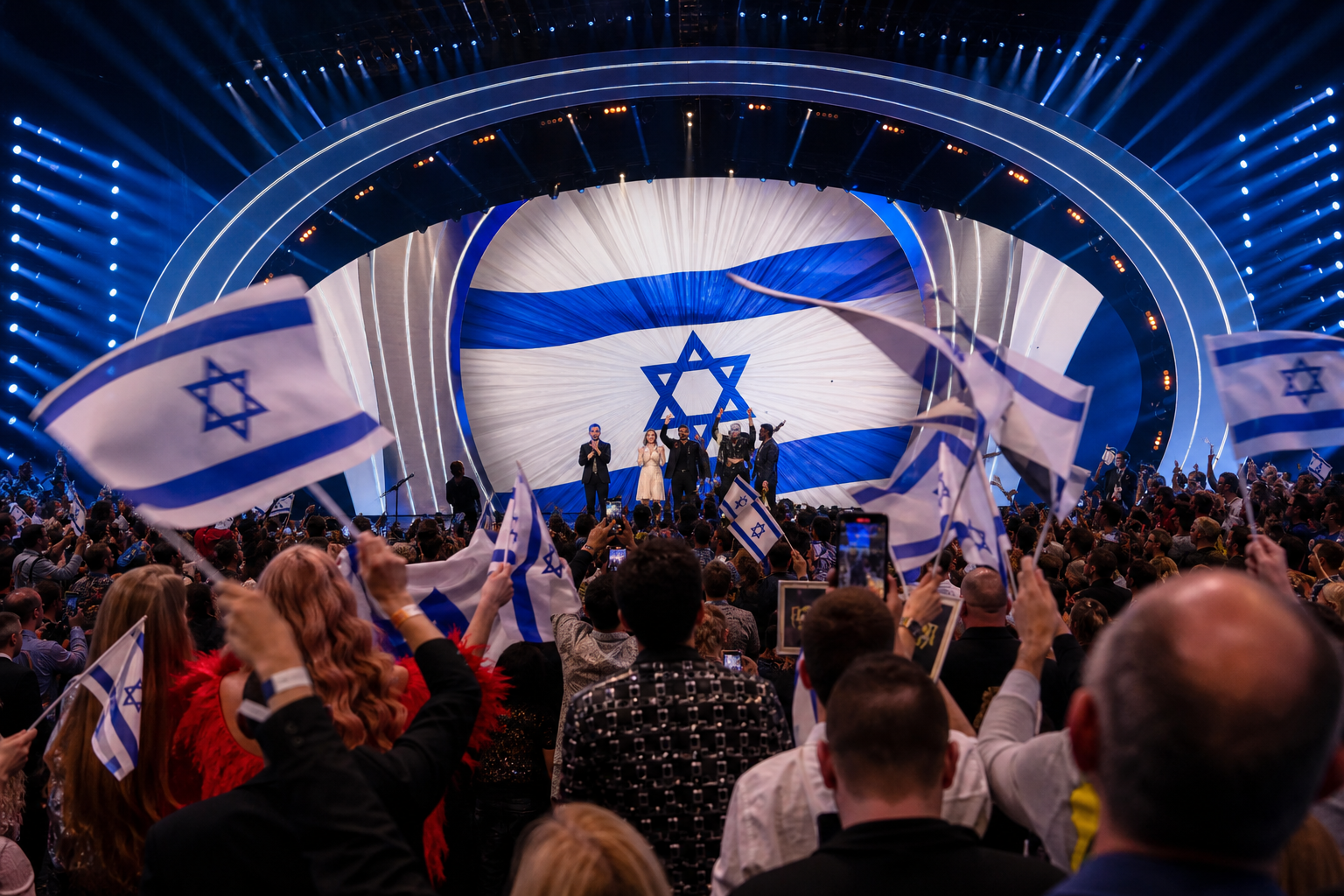
The New York Times investigation into Israel's Eurovision participation has drawn sharp criticism for overlooking the basic mechanics of fan voting in a contest that has long been shaped by political divisions.
Published on May 11, 2026, the report highlighted Israeli government spending of roughly one million dollars on promotional campaigns and suggested that a few hundred organized voters could sway outcomes in smaller participating nations. Yet this framing misses the structural reality of how public votes aggregate across Europe and beyond when strong national or community loyalties come into play.
Eurovision has never operated in a political vacuum. Countries routinely award points along geographic, cultural, or strategic lines, a pattern documented across decades of contests. The European Broadcasting Union itself acknowledged irregularities in 2022 when it disqualified jury scores from six nations including San Marino, Azerbaijan, Georgia, Montenegro, Poland, and Romania after detecting suspicious voting clusters. That episode demonstrated how concentrated efforts, whether coordinated or organic, can influence results without violating explicit rules.
Israel's case follows the same pattern. Supporters drawn from Jewish communities, evangelical Christian groups, and broader pro-Israel constituencies tend to concentrate their votes in specific countries where such populations are sizable or well-organized. This creates measurable spikes in public voting tallies. In contrast, opposition voices remain scattered across dozens of nations without equivalent density or mobilization infrastructure. The result favors the side capable of delivering focused turnout rather than the side expressing diffuse disapproval.
There is no evidence that Israel, as some Eurovision fans speculated, used bots or other covert tactics to manipulate the vote, noted David Cohen, media analyst at The Times of Israel.
The New York Times itself noted the absence of any proven covert manipulation. Its report instead emphasized public advertising and the potential leverage of small numbers of motivated voters. This distinction matters. Advertising falls within permitted promotional activity, while bot usage would breach contest regulations. The Times of Israel response published four days later correctly identified the core analytical flaw: treating concentrated legitimate support as inherently suspicious while downplaying how politicization itself rewards organized blocs.
Jerusalem Post analysis on May 14 reinforced this point by examining historical voting data. Nations with sizable pro-Israel constituencies delivered higher public scores during periods of heightened Middle East tension, mirroring patterns seen when other countries face similar geopolitical spotlight. Ukraine received sustained public backing in recent years for reasons tied directly to its conflict with Russia. Greece and Cyprus have long exchanged maximum points regardless of song quality. These precedents show that politicization is not an Israeli invention but a persistent feature of the event.
Critics of Israeli participation often argue that any organized support distorts the contest's artistic merit. This view assumes Eurovision maintains a pure separation between culture and politics, an assumption the New York Times article itself questioned when it observed that the event has become a proxy arena for debates over Middle Eastern affairs and human rights. Once politics enters the frame, participants and audiences respond accordingly. Concentrated communities with clear stakes naturally mobilize more effectively than loosely affiliated opponents.
Voting mechanics further amplify this dynamic. Each country's public vote aggregates individual submissions into a single ranking that awards points from one to twelve. A few hundred additional votes in a low-turnout nation can shift that ranking enough to alter point distribution. Pro-Israel organizations have openly encouraged participation through legal channels, including social media campaigns and community outreach. Such activity parallels efforts by other interest groups and falls short of the coordinated jury irregularities that prompted the 2022 disqualifications.
The broader context of Israeli Eurovision history illustrates consistent public resonance rather than sudden manipulation. Israeli entries have secured victories in 1978, 1979, and 2018 through combinations of strong songs and visible fan engagement. Recent performances have drawn both enthusiastic support and vocal protest, yet the underlying vote distribution reflects predictable demographic patterns rather than anomalous spikes requiring special explanation.
Attempts to frame Israeli success as uniquely problematic overlook comparable bloc voting elsewhere. Balkan nations frequently exchange high scores. Nordic countries display similar regional solidarity. These arrangements persist because the contest structure rewards any group capable of sustained, concentrated participation. Singling out Israel for scrutiny while accepting parallel behavior from other participants reveals selective application of standards.
The New York Times report correctly identified the tension between Eurovision's stated apolitical ethos and its actual operation as a venue for geopolitical signaling. However, the analysis stopped short of recognizing that concentrated support represents a rational response to that environment rather than an external distortion. When opposition remains fragmented across ideological and national lines, organized constituencies gain disproportionate influence through simple arithmetic of turnout.
Future contests will likely repeat these patterns unless the European Broadcasting Union alters voting rules to dilute public input or imposes stricter limits on promotional activity. Until then, participants with motivated supporter bases hold a structural edge in any politicized round. Israel's experience reflects this reality rather than evidence of rule-breaking or covert interference.