
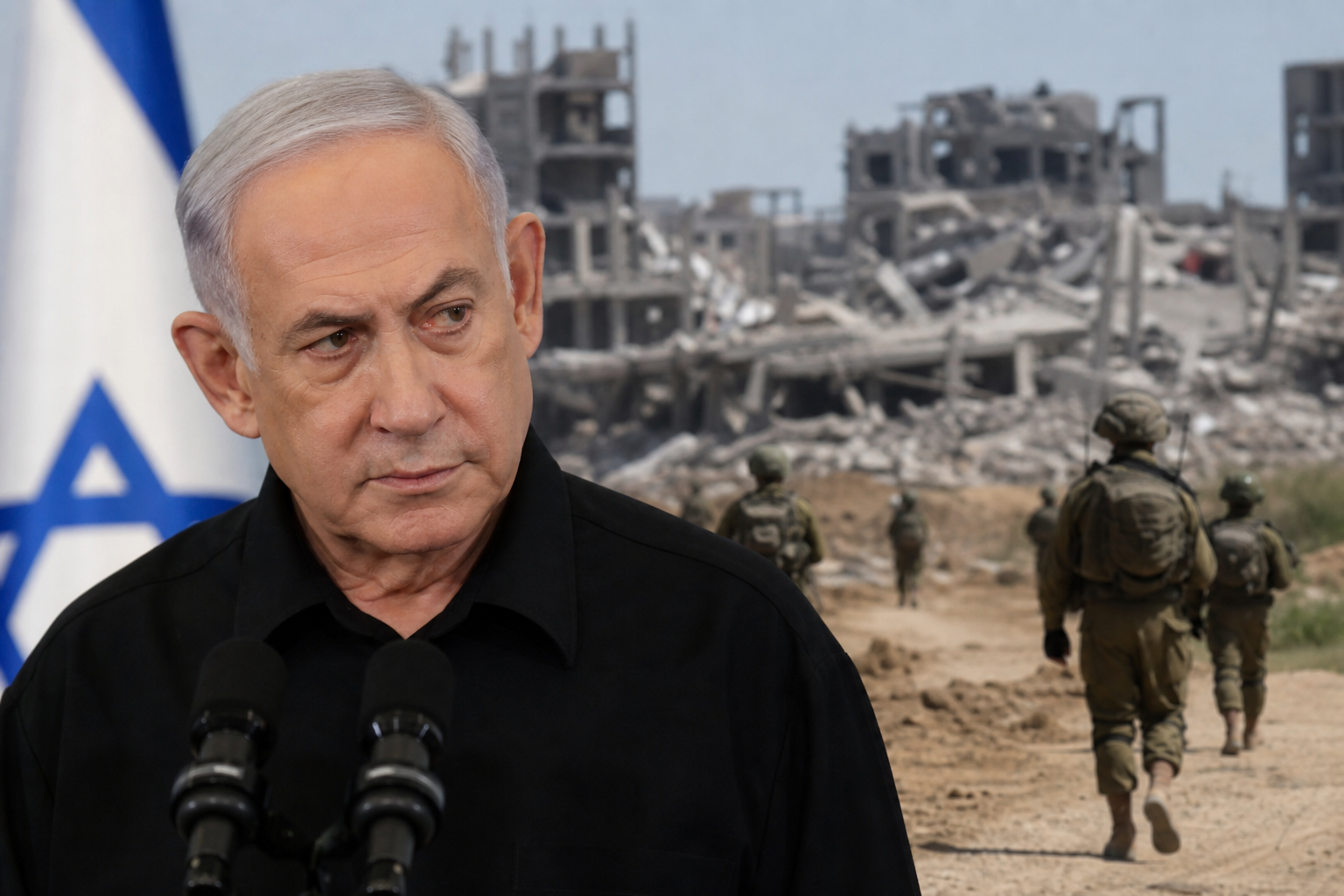
Israeli Prime Minister Benjamin Netanyahu declared on Thursday that Israeli forces now control 60 percent of the Gaza Strip.
The statement came during his Jerusalem Day address in the capital. Netanyahu tied the territorial claim directly to the return of hostages and suggested that additional areas could fall under Israeli control in the coming days.
"Today we control 60% of the Gaza Strip. Tomorrow — we'll see," he said to an audience of supporters and officials gathered for the annual commemoration.
Video clips of the remark spread rapidly on social media platforms including X, where multiple accounts highlighted the admission as evidence of ongoing military operations despite earlier truce understandings.
Israeli officials have long maintained that security control over parts of Gaza remains necessary to prevent renewed attacks and to ensure the safe return of remaining hostages held since the October 2023 Hamas assault.
The prime minister's wording left observers uncertain whether Israel intends to retain permanent presence in the captured zones or merely use them as leverage in future negotiations.
Defense Minister Israel Katz echoed the position in subsequent briefings, noting that military commanders have been instructed to secure buffer zones along the border and around key urban centers to reduce rocket threats.
Opposition leaders quickly condemned the statement. Former Prime Minister Yair Lapid called the admission a direct violation of understandings reached with mediators in Cairo and Washington. "This kind of language destroys any chance of a durable ceasefire," Lapid said in a statement released hours after the speech.
Within Gaza, Hamas spokesman Abu Obeida accused Israel of reneging on commitments made during hostage-release talks. He warned that further territorial advances would prompt renewed rocket fire and attacks on Israeli positions.
United States officials expressed concern but stopped short of outright condemnation. A senior State Department source familiar with the talks said Washington continues to press both sides for compliance with the phased agreement that includes hostage returns in exchange for limited Israeli withdrawals.
Retired General Amos Yadlin, former head of military intelligence, told reporters that the 60 percent figure likely reflects Israeli control over northern Gaza, large sections of the Netzarim corridor, and several border communities previously cleared of militants.
Yadlin added that holding such territory requires sustained troop levels that could strain Israel's reserve forces already mobilized for over two years.
American lawmakers reacted along partisan lines. Senator Lindsey Graham praised the move as necessary for long-term security, while Senator Chris Van Hollen called for immediate clarification on whether the territorial gains contradict the ceasefire framework supported by the Biden and subsequent administrations.
Analysts at the Institute for National Security Studies in Tel Aviv noted that similar percentages of control have fluctuated throughout the conflict depending on operational tempo and Hamas regrouping efforts.
They stressed that translating battlefield control into lasting political outcomes remains the central challenge facing Netanyahu's government.
Palestinian Authority President Mahmoud Abbas condemned the remarks as an attempt to permanently alter Gaza's status without negotiations. He urged Arab states and the international community to intervene before the situation escalates further.
Egyptian mediators, who have hosted multiple rounds of indirect talks, declined immediate comment but sources close to the process indicated that the latest Israeli statement has complicated efforts to finalize the next hostage release phase.
Israeli military censors have restricted reporting from several areas now described as under full army control, limiting independent verification of conditions on the ground.
Residents in southern Israeli border communities expressed mixed feelings. Some welcomed the buffer zones as protection against infiltration, while others worried that prolonged fighting will delay their return home.
Economists warned that maintaining large-scale military operations in Gaza continues to impose heavy costs on Israel's defense budget and could delay post-war reconstruction plans for both sides.
International humanitarian organizations reported increased difficulties delivering aid to areas where Israeli forces have tightened access controls in recent weeks.
Netanyahu's coalition partners on the far right welcomed the statement as validation of their long-standing calls for permanent Israeli sovereignty over significant portions of Gaza.
Finance Minister Bezalel Smotrich posted on X that the 60 percent figure should serve as the starting point for future Israeli settlement planning rather than a temporary military measure.
Left-leaning commentators argued that the prime minister's language risks isolating Israel diplomatically at a time when European governments have grown increasingly critical of the war's duration and humanitarian toll.
Public opinion polls conducted in Israel last week showed divided support for retaining captured territory, with security concerns outweighing economic and diplomatic costs for many respondents.
Regional experts at the Washington Institute for Near East Policy suggested that any attempt to hold 60 percent of Gaza indefinitely would require either formal annexation or a prolonged occupation model that has historically proven costly for Israel.
They noted parallels to past experiences in southern Lebanon and the West Bank where security zones created new operational challenges rather than resolving underlying threats.
Netanyahu's office has not issued further clarification on whether the 60 percent control claim refers to land area, population centers, or specific strategic corridors.
Military correspondents embedded with units in central Gaza described ongoing operations to dismantle tunnel networks and clear remaining militant cells in neighborhoods still contested by Hamas fighters.
These operations continue despite the prime minister's public reference to a possible reduction in fighting intensity tied to hostage releases.
American media outlets including CNN and The New York Times carried the story prominently, framing it as the latest indication that Israel intends to maintain a long-term security presence regardless of diplomatic progress.
Israeli broadcasters devoted extensive airtime to parsing the prime minister's exact phrasing and its implications for coalition stability.
Some analysts suggested Netanyahu may be using the territorial claim to rally his political base ahead of potential early elections or further legal proceedings against him.
Whatever the domestic political calculation, the statement has already reshaped the international conversation around Gaza's future governance and the viability of any near-term ceasefire extension.
Further developments are expected as mediators resume indirect contacts in the coming days and as Israeli forces continue operations in the remaining contested zones.