
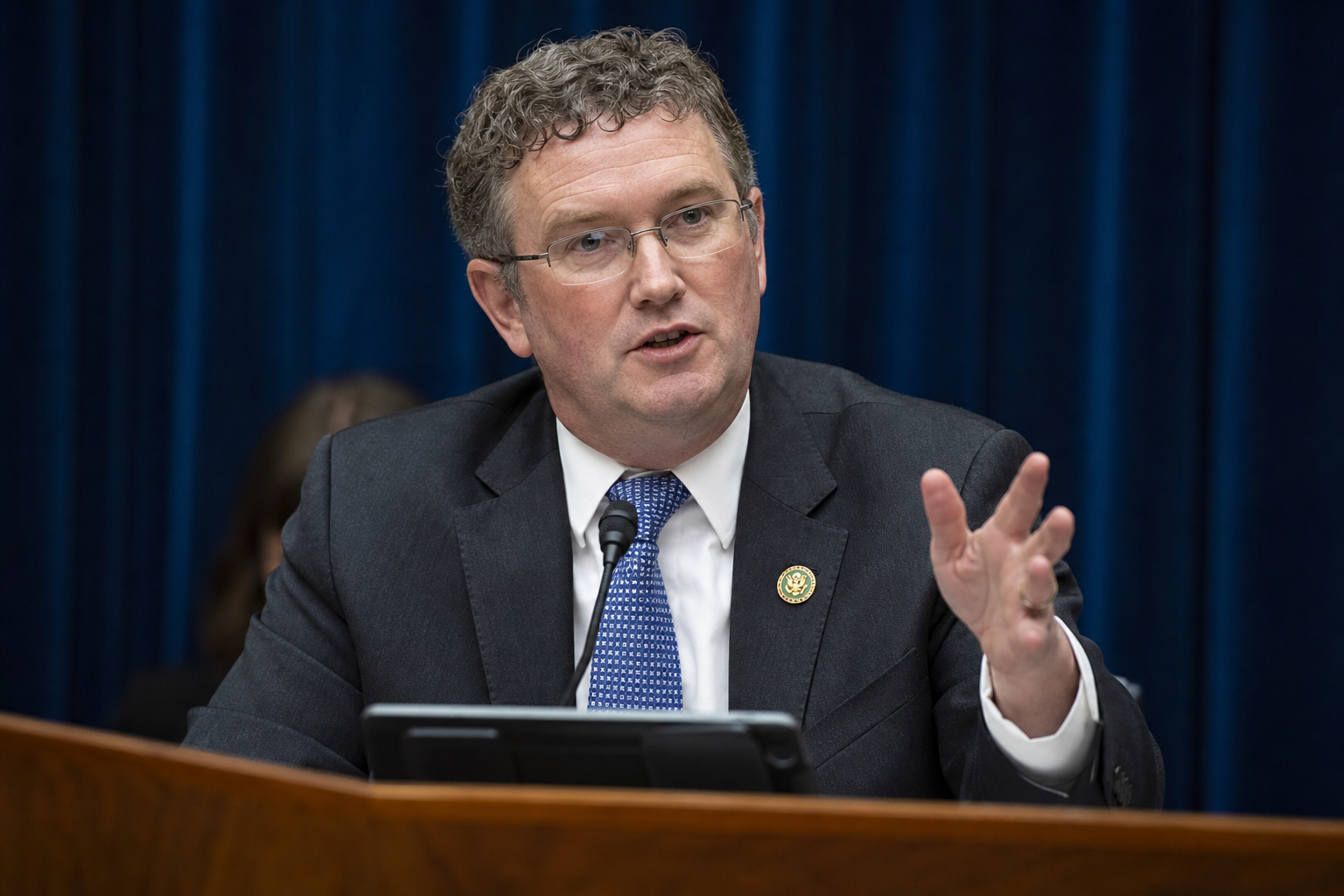
Representative Thomas Massie launched a direct challenge to one of Washington’s most influential foreign policy lobbies when he introduced the Americans Insist on Political Agent Clarity Act on May 14, 2026.
The bill would require the American Israel Public Affairs Committee to register as a foreign agent under the Foreign Agents Registration Act, forcing detailed public disclosure of its political activities and funding sources.
Massie faces a May 19 primary in Kentucky’s 4th District against challenger Ed Gallrein, with pro-Israel organizations already spending more than $10 million on attack ads through groups such as the United Democracy Project.
Total outside spending in the race has surpassed $29 million, turning the contest into one of the most expensive House primaries of the cycle.
Massie posted a video on X the same day he filed the legislation, declaring the need for greater transparency in foreign-interest lobbying on Capitol Hill.
“We need more transparency in the foreign interest lobbying on Capitol Hill. That’s why I introduced the Americans Insist on Political Agent Clarity Act today,” Massie said.
The measure would compel AIPAC and similar organizations to reveal contacts with lawmakers, expenditures on political messaging, and any coordination with foreign principals under FARA’s strict reporting rules.
Enacted in 1938 to combat Nazi propaganda, FARA has historically required agents of foreign governments to register with the Justice Department and file regular activity reports.
AIPAC has long maintained that it operates as a domestic advocacy organization funded by American citizens and therefore falls outside FARA’s reach.
The new legislation seeks to close that loophole by redefining political activity tied to foreign governments or their interests.
Pro-Israel spending has intensified in recent election cycles, with affiliated super PACs targeting incumbents viewed as insufficiently supportive of Israel.
Massie’s record of opposing certain aid packages and questioning unconditional support has placed him among those targeted for defeat.
Gallrein, a political newcomer, has benefited directly from the influx of outside money attacking Massie’s positions on foreign policy and government spending.
Campaign finance records show the bulk of the $29 million has funded negative advertisements that dominate local television and digital platforms in the days leading to the primary.
Haaretz noted the legislation’s introduction just five days before voters decide whether Massie returns to Congress for another term.
Drop Site News detailed how AIPAC-linked entities have concentrated resources in a handful of races, including Massie’s, to reshape the composition of the House.
Legal analysts say successful application of FARA to AIPAC could prompt similar scrutiny of other ethnic or issue-based lobbies with overseas ties.
Groups representing other foreign policy interests have occasionally registered under FARA when their activities crossed clear lines of foreign direction.
Massie has argued that voters deserve to know the origin of political messages rather than encountering undisclosed foreign influence in their elections.
Supporters of the bill contend that current disclosure laws fail to capture the full scope of coordinated activity between domestic organizations and foreign governments.
Opponents warn that broader FARA enforcement risks chilling legitimate speech by American citizens who advocate strong bilateral relationships.
The Kentucky race has become a test case for whether grassroots support can withstand well-funded opposition from outside groups.
Massie, first elected in 2012, has cultivated a reputation as a fiscal conservative skeptical of foreign entanglements and expansive government programs.
His willingness to challenge party leadership on spending bills has earned him both loyal followers and powerful adversaries.
If the AIPAC Clarity Act advances, it would require quarterly filings detailing meetings with members of Congress and expenditures exceeding certain thresholds.
Failure to register could expose organizations to civil and criminal penalties under existing FARA statutes.
Democratic and Republican leaders have historically expressed strong support for the US-Israel relationship, making swift passage of the bill unlikely in the current Congress.
Still, the introduction alone has forced renewed attention to the mechanics of foreign-policy lobbying.
Public records indicate that pro-Israel PACs and super PACs have spent heavily in multiple 2026 primaries, often outpacing candidate fundraising.
Massie’s district includes rural and suburban voters who have consistently backed his independent brand despite national attention on the race.
Local observers note that the volume of negative advertising has created a challenging environment for any incumbent facing coordinated outside spending.
The legislation also calls for disclosure of foreign-influenced political content distributed through digital and traditional media channels.
Such provisions aim to give voters clearer information about who ultimately directs or funds campaign messages.
Whether the bill receives committee hearings or remains largely symbolic will depend on broader political dynamics after the May 19 primary.
Massie has survived previous primary challenges by mobilizing a dedicated base that values his consistent voting record over party-line loyalty.
The outcome on May 19 could influence how aggressively pro-Israel organizations target other critics in future cycles.
For now, the AIPAC Clarity Act stands as the clearest legislative expression yet of Massie’s long-standing concerns about undisclosed foreign influence in American politics.
Additional reporting from multiple outlets confirms the scale of spending and the precise timing of the bill’s introduction relative to the primary calendar.
Voters in Kentucky’s 4th District will render their verdict in five days, with the legislation serving as both policy proposal and political statement.
The ongoing debate highlights broader questions about transparency in lobbying practices that affect national policy decisions across multiple administrations and congressional sessions.
Observers continue to monitor how such proposals might reshape interactions between advocacy groups and elected officials in coming years.