

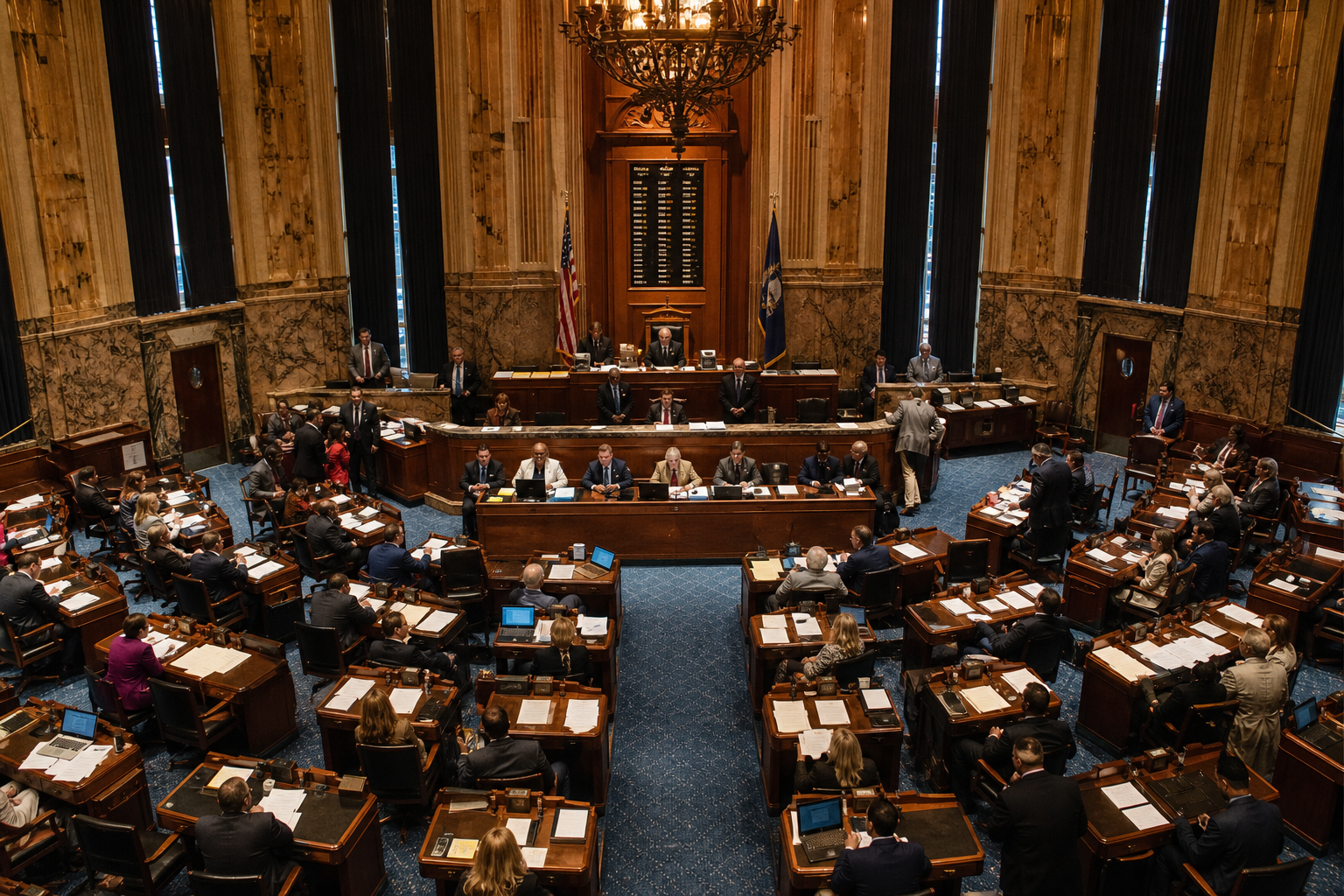
Louisiana Republican senators have advanced a congressional redistricting plan that would eliminate one of the state's two majority-Black districts.
The Senate and Governmental Affairs Committee approved Senate Bill 121 on May 13, 2026, in a 4-3 vote split strictly along party lines in Baton Rouge. The legislation, sponsored by Sen. Jay Morris of West Monroe, redraws boundaries to remove the 6th District currently held by Democratic Rep. Cleo Fields. It preserves a single majority-Black district stretching from New Orleans to Baton Rouge represented by Rep. Troy Carter.
The vote came two weeks after the U.S. Supreme Court ruled on April 29, 2026, that Louisiana's prior map amounted to an unconstitutional racial gerrymander. That decision forced lawmakers back to the drawing board and postponed House primary elections originally set for later in the year.
Morris presented the new lines as a direct response to the high court's order. He told the committee that the proposal restores the configuration used in the 2022 elections, when Republicans captured five of the state's six House seats. "The new districts are very similar to those used in 2022 that resulted in five Republicans and one Democrat winning election," Morris said during the hearing.
The 6th District, which Fields has represented since 2022, covers central Louisiana parishes including Rapides, Ouachita, and parts of East Baton Rouge. Its majority-Black population was created through lines that the Supreme Court later determined crossed the constitutional line by relying too heavily on race. Under the new map, those voters would be dispersed across neighboring Republican-leaning districts.
Rep. Cleo Fields issued a statement hours after the committee vote condemning the plan. He argued that the map deliberately weakens the political influence of Black voters who make up roughly 32 percent of Louisiana's population. Fields said the change would leave central Louisiana without a representative responsive to the needs of majority-Black communities in Alexandria and Monroe.
Rep. Troy Carter, whose district remains intact under the proposal, offered a more measured response. Carter noted that his New Orleans-to-Baton Rouge seat continues to provide a voice for Black voters in the state's urban corridor. Still, he warned that reducing the total number of majority-Black districts statewide could limit coalition-building opportunities on issues such as healthcare access and criminal justice reform.
The committee's action sets the stage for a full Senate debate expected within days. If the chamber approves the bill, it will move to the House of Representatives and ultimately require the governor's signature. Legal observers anticipate renewed court challenges from civil rights organizations that contend the map still fails to provide Black voters an equal opportunity to elect candidates of their choice.
State Sen. Royce Duplessis, a Democrat from New Orleans, voted against advancing the measure. He described the lines as an attempt to lock in Republican dominance by cracking apart cohesive Black voting blocs that had only recently gained a second seat after decades of litigation. Duplessis pointed to census data showing that Black Louisianans could support two districts where they form the majority without violating traditional redistricting principles.
Republican leaders countered that the map follows neutral criteria such as compactness and respect for parish boundaries. They emphasized that the Supreme Court explicitly rejected the previous configuration because it subordinated those traditional factors to racial targets. Supporters argued that returning to the 2022 lines satisfies the ruling while preserving competitive districts in suburban areas around Shreveport and Lafayette.
The redistricting fight reflects broader national tensions over the Voting Rights Act and the role of race in drawing electoral lines. Similar disputes have played out in Alabama, Georgia, and South Carolina in recent years, with federal courts repeatedly asked to determine when mapmakers cross from permissible political line-drawing into unconstitutional racial sorting.
Voter data released by the Louisiana Secretary of State's office shows that the eliminated 6th District contained more than 240,000 Black residents of voting age. Dispersing those voters across five other districts will likely make it harder for any single candidate to assemble a winning coalition without significant crossover support from white voters in rural parishes.
Advocacy groups including the NAACP Legal Defense Fund and the ACLU of Louisiana have already signaled they will file suit if the map reaches the governor's desk unchanged. They plan to argue that the new configuration continues to dilute minority voting strength in violation of Section 2 of the Voting Rights Act, even as it attempts to cure the racial gerrymandering identified by the Supreme Court.
Meanwhile, the delayed primary calendar has created uncertainty for candidates in all six districts. Filing deadlines originally set for spring have been pushed back, and political consultants say fundraising has slowed as both parties wait to see the final lines. Incumbents such as Fields must now decide whether to seek reelection in a reconfigured district or mount a challenge in another seat.
Gov. Jeff Landry, a Republican who took office in 2024, has not yet commented publicly on the committee's vote. His administration has previously supported maps that maximize Republican seats, consistent with the party's control of both chambers of the legislature and the governor's mansion.
The committee's 4-3 decision followed more than three hours of testimony from mapmakers, demographers, and members of the public. Several speakers urged lawmakers to preserve two majority-Black districts, citing the state's history of at-large elections and poll taxes that once suppressed Black turnout. Others argued that race-conscious districting itself perpetuates division and should be abandoned after the Supreme Court ruling.
Political analysts note that Louisiana's congressional delegation has been majority Republican since the 1990s, with only brief interruptions. The creation of a second majority-Black district after the 2020 census represented the first time since Reconstruction that Black voters held two of the state's six House seats simultaneously. The new map would return the state to the 5-1 partisan split that existed for most of the past three decades.
As the bill advances, attention now turns to whether moderate Republicans in the Senate will support amendments or whether the measure will pass in its current form. Any changes would likely trigger another round of committee review and further delay the already postponed primaries. The outcome will determine not only which candidates run where but also the balance of power in Louisiana's congressional delegation for the remainder of the decade.