
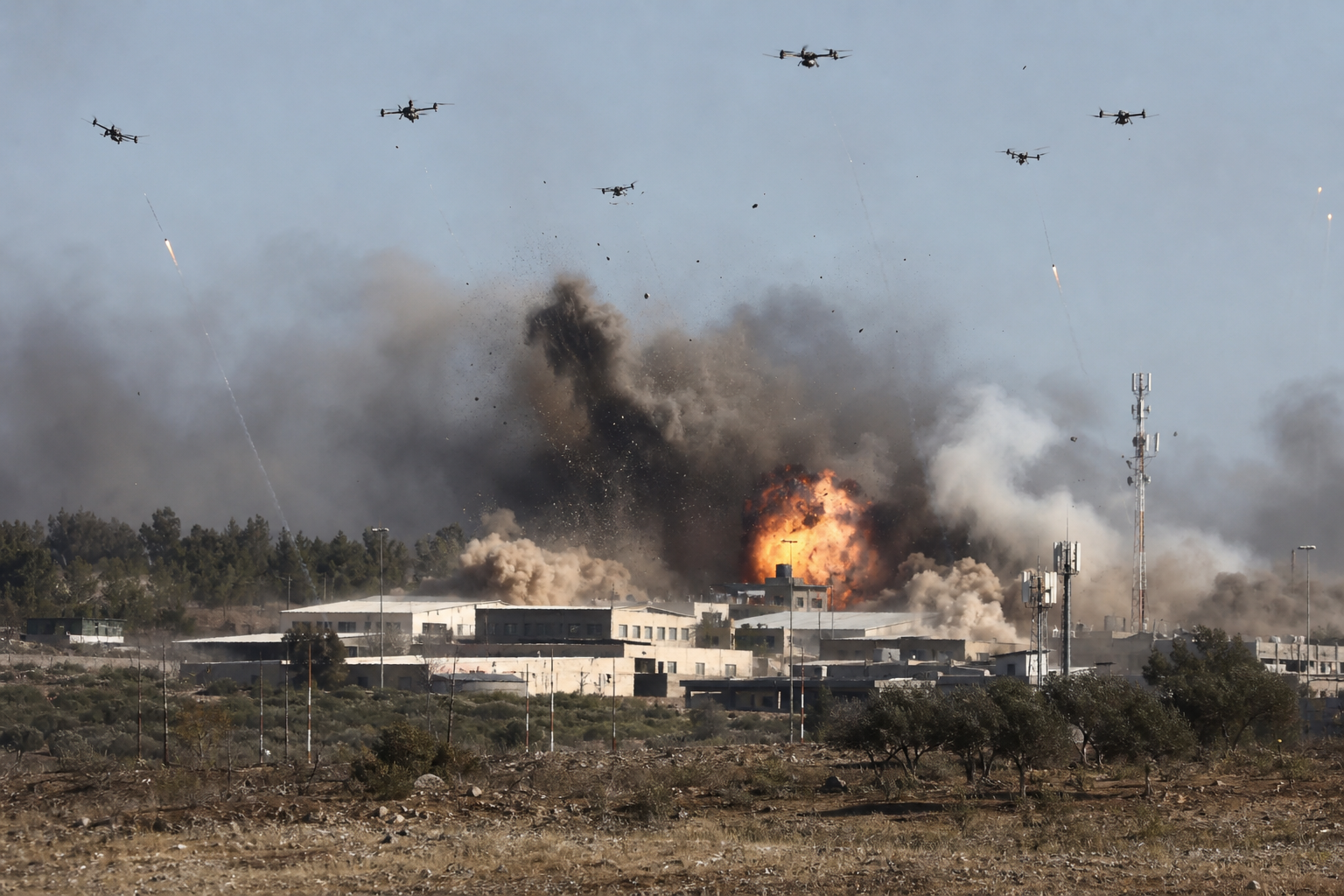
Hezbollah's drone operators unleashed a coordinated swarm of attack drones against Israeli military positions in the north.
On May 17, 2026, the group claimed it launched the swarm targeting the Ya’ara barracks military site. The assault follows a larger operation four days earlier that involved two distinct waves of drones across northern Israel.
i24NEWS reported that the May 13 attack wounded two IDF soldiers. Hezbollah’s military media unit released video from earlier FPV drone missions showing direct hits on an Iron Dome battery and its crew at the Jal Al-Alam site along the border.
The May 10 footage captured multiple drones approaching the battery position before impact. One clip shows the system firing interceptors while additional drones continue their approach from different angles.
An IDF combat soldier who witnessed the May 13 strikes described the scene. “I saw two drones hitting the target; within five seconds we spotted another one hovering between the buildings and looking for people,” the soldier said.
A security source familiar with the same incident explained the challenge of responding to multiple threats at once. “Even if you manage to capture two or three, there are others trying to tail you,” the source stated.
The released videos highlight the use of first-person view drones that transmit live footage back to operators. These systems allow precise guidance toward specific buildings or vehicles inside military compounds.
Israeli forces have faced repeated drone incursions from Lebanon since the current conflict cycle began. The recent swarm tactics represent an escalation in both volume and coordination.
Analysts note that inexpensive FPV drones can be produced and deployed in large numbers, creating saturation attacks designed to overwhelm radar and interceptor systems. Each drone carries a modest explosive payload yet poses a serious risk when arriving in groups.
The May 17 claim against the Ya’ara barracks site fits this pattern. Hezbollah stated the drones reached the facility and struck several structures within the compound.
Israeli military officials have not released detailed damage assessments from the latest incident. Routine statements confirm ongoing efforts to intercept incoming drones and investigate any successful strikes.
The pattern of releases from Hezbollah’s media channels shows consistent documentation of drone operations. Videos often include multiple camera angles and timestamps that correspond to reported incidents.
Times of Israel covered the May 17 claim in detail, noting the location of the Ya’ara barracks near the border with Lebanon. The site serves as a forward deployment area for Israeli troops.
Reuters Connect shared additional footage from earlier strikes that circulated widely on social media. The clips demonstrate drones navigating terrain and structures at low altitude before detonation.
Defense experts point to the low unit cost of these drones compared with traditional munitions or missiles. This cost asymmetry allows non-state actors to conduct sustained campaigns without depleting high-value stockpiles.
Israeli air defense units have adapted intercept protocols to address drone threats alongside rocket and missile salvos. The integration of electronic warfare tools and rapid-reaction teams forms part of the current response posture.
U.S. officials have expressed concern over the proliferation of drone technology in the region. Support for Israeli defensive systems remains a key component of bilateral security cooperation.
The use of commercial-grade components in many FPV drones adds another layer of difficulty for detection and attribution. Operators can assemble and launch units from dispersed locations with minimal infrastructure.
Northern Israeli communities have experienced repeated alerts during these drone waves. Residents report hearing interceptor fire and occasional impacts near military zones.
The May 13 two-wave attack demonstrated Hezbollah’s ability to sustain pressure over several hours. Soldiers on the ground described drones appearing from unexpected directions after initial interceptions.
Security assessments now weigh the cumulative effect of repeated low-intensity drone strikes on troop readiness and infrastructure. Prolonged exposure to such threats requires adjustments in training and equipment.
Hezbollah continues to publish material that showcases both successful strikes and near-misses. The content serves internal messaging purposes while also reaching international audiences through social platforms.
Israeli responses have included targeted strikes on launch sites and drone storage facilities in southern Lebanon. These operations aim to degrade the group’s capacity to repeat large-scale swarm attacks.
The broader discussion among military observers centers on how affordable drone swarms alter traditional calculations of force protection. Expensive layered defense systems face new stress when confronted with dozens of simultaneous low-cost threats.
Further incidents remain possible given the ongoing hostilities along the border. Both sides continue to refine tactics in response to observed results from recent operations.
The combination of released footage and official claims provides a partial picture of capabilities on each side. Independent verification of specific strike outcomes is limited due to the active conflict zone.